From Click to Client Podcast · Episode 91
How to Be Magnetic and Make People Listen
Why being great at your work doesn't guarantee you'll be heard, and the three things that make people stop and listen.
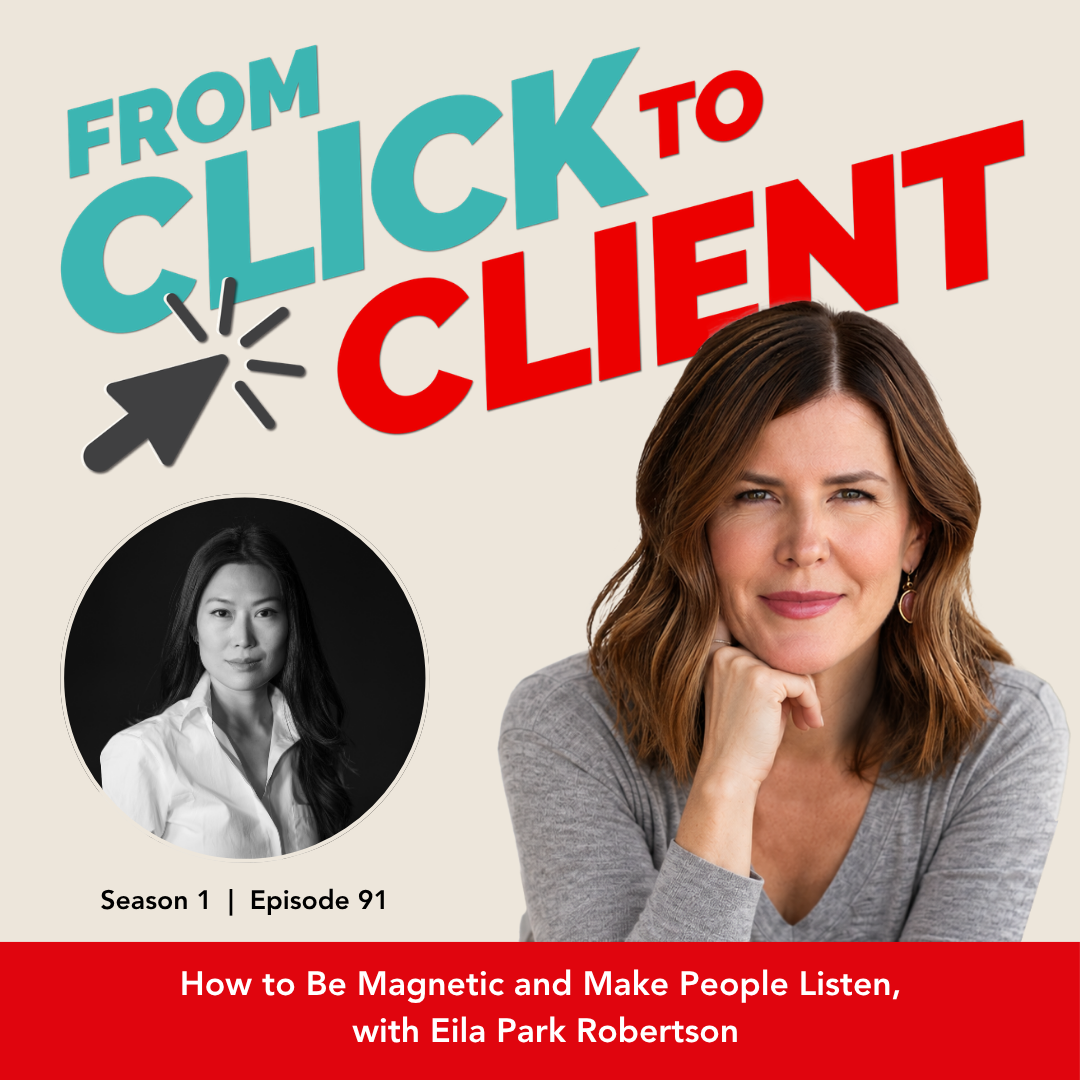
Episode 91
How to Be Magnetic and Make People Listen, with Eila Park Robertson
Loading the player…
🎧 Apple Podcasts | Spotify | YouTube
About This Episode
You can be great at what you do and still struggle to get people to listen. Some of the most capable leaders Eila Park Robertson knows get maybe 100 views on a post. Personal branding works when people can feel who you are and trust what you're saying, and that takes a different skill than doing the work itself.
In this episode, I'm talking with my longtime friend Eila Park Robertson, founder of Anecdotia and COMMS HQ. Eila spent more than 20 years in broadcast news, and today the stories she posts average around three million views a month. Years ago I asked her to teach me how to be magnetic on camera, and back then she couldn't explain what came so naturally to her. Now she can.
We get into the three things behind magnetic communication: certainty, emotion, and practice. Eila shares how she scripts her videos, why neutral content gets scrolled past, and the simple practice she wants you to try before you post your next story.
What You'll Walk Away With
- Why experts and leaders get drowned out online, even when their work speaks for itself
- The quality Eila calls the spine of every story, and why it keeps people listening
- How to script a video so it stays sharp without sounding rehearsed
- The warm-up she does before recording, and why it should feel awkward at first
Questions This Episode Answers
How do you become more magnetic on camera?
Speak with certainty, put a real emotion in every story, and practice before you record. Eila Park Robertson says certainty is what puts people at ease, and emotion is what draws the right people to you.
Why doesn't anyone engage with my social media posts?
Often the content is neutral. Eila's rule is that if a story doesn't trigger an emotion in you, it won't trigger one in the person watching. Timing and a compelling story matter too.
How do you sound natural when reading from a script?
Script about 80% of what you'll say and leave the rest off the cuff. The script keeps you sharp, and the unscripted part lets people see the emotion behind your words. Then read it out loud three times before you record.
How many takes should you do when recording a video?
More than you think. Eila averages about five takes per story and sometimes does eight or nine. In her words, if it's taking a lot of time, you're doing it right.
"Being natural is the ultimate gift as a communicator. And you don't get there, oddly, naturally. It takes a lot of effort."
Eila Park Robertson
Meet Eila Park Robertson

Eila Park Robertson is the founder of Anecdotia, an award-winning progressive communications agency. She most recently launched COMMS HQ, a hub to train and invest in the most powerful storytellers of our time.
For more than 20 years, she has been on the frontlines of media as a communications executive and broadcast journalist. She is a longtime champion for people, animals, and the planet, and is proud to serve on IFAW's Global Board of Directors, one of the world's most active conservation NGOs.
Connect with Kris Jones

Kris Jones is the founder of Red Door Stories, a Certified StoryBrand Guide, and a messaging strategist who helps service providers, coaches, and consultants clarify their marketing message so they can attract consistent clients. Her core belief: simplicity is a strategic advantage. Less noise, clearer message, more traction.
Book a Growth Gameplan Call
Take the Free Client Attraction Scorecard
Follow on Instagram
Subscribe to Kris's YouTube Channel and Learn How to Attract More Clients
📖 Episode transcript
Kris: [00:00:00] Welcome to the show Eila Park Robertson. Eila has spent more than 20 years in broadcast news, and then government work here in Portland, which was tumultuous, to put it mildly. Mm-hmm. And now she runs her own agency called Anecdotia out of Vancouver, Canada. She helps leaders learn how to be heard, and today we're gonna talk about what makes someone magnetic. And how you can do that for yourself. So Eila, I am so thrilled to have you here.
Eila: [00:00:35] Kris, I am so honored, so honored.
Kris: [00:00:39] So you started out in TV, and, full disclosure, Eila and I lived together for- several years when she was here in Portland, and we became family to each other, and it was such- Mm ... a beautiful time of connection and learning for me. And way back then, I had asked Eila to teach me, teach me how to be good at talking on camera and speaking to people and using my voice and becoming magnetic. And, and we, we never really did that, because she wasn't quite at that point yet to teach what she has mastered. but now this is exactly what she is doing, and she has stopped everything with her agency to focus on- Teaching and helping other voices be heard because now more than ever we need to be heard, andYou mentioned this in a post the other day. Like, we take the time to learn different skills- Mm-hmm ... in our lives, but rarely do we take the time to hone and train our own voice and the skill behind being heard and being magnetic to get what we want, and not, not necessarily in a selfish way, but to either help our clients or to get our ideas out there or there or to, create a movement around what we're passionate about, right? Mm-hmm. So you started in TV doing- Yeah ... news, waking up- Mm-hmm ... at, like, 3:30 in the morning. Um- Mm-hmm ... w- day after day. I don't know how you did it. But what did that chapter of your life teach you?
Eila: [00:02:30] Everything. Everything that I know now. When you asked me to teach you how to do what I do, what, 10 years ago, I, I really thought about it. I was like, "Yeah, sure, I'll teach you," but this, it- to me it was instinct, not something that I could point to about this is what you do to do this, this is what you do to do that, because I, I already had about 10 years under my belt in news, and so it wasn't something that I thought about, it's just something that I did. So I really struggled to find what was teachable about that. All that has changed with time and maturity and understanding that there are real mechanisms behind what I'm able to do, and now I can pinpoint exactly how to do what I do. I, but I couldn't then for some reason. And the genesis of Comms HQ, which I just birthed, like, a couple days ago, is it, it's rooted in this desire to demand that we elevate the conversation. I am no longer asking nicely. I don't want anyone else to ask nicely. I don't want anyone to ask for permission anymore. We're just going to do it. And that was my first awakening, a year ago when I started speaking out way more publicly about very conservative communications and the methodology behind that and how it relates to the rise of fascism. I realized this discourse wasn't happening. People were just freaking out about how this is playing out, and I just started just educating, "No, this is a playbook. This is how you make people incensed. Then you make them focus on other things, and then you drop all these other bombs, literally and figuratively, so that they don't focus on the real thing that you're doing." And so there's this whole strategy behind how the super right and the right distract and deploy comms as a weapon. Mm. And so I started speaking out on that, and people, I kept getting messages saying, "I've never heard anyone distill it like this or break it down like this." And that's when I realized I need to do this for the masses. I need to do this. I need to have a real training module for people who can start to command rooms, any room they want, with, with, the intensity behind what they're saying, with any intensity.
Kris: [00:05:10] Right. And really, the playbook, and correct me if I'm wrong, but the, the playbook is about creating chaos and distraction- Mm-hmm for the masses to help us feel overwhelmed and disempowered, and, like, what we have to say and do doesn't matter.
Eila: [00:05:29] Right. Exactly. And that's really effective. It's been- Mm ... really effective.
Kris: [00:05:35] Yeah, unfortunately.
Eila: [00:05:37] Yeah. Mm-hmm.
Kris: [00:05:37] you have mentioned that you've watched people you respect get drowned- Mm ... out. What, what's happening there?
Eila: [00:05:46] There is this misconception that if you are the quietest voice in the room, or if you're more of a pragmatist and you're more of a bridge builder, that you won't be heard in the way that you need to be heard. Your message gets drowned out by the more chaotic, narratives out there. There is some truth to that, But it's not the whole story. That's not the reason why people aren't being heard. So I have incredible, incredible friends who are community leaders, and they may get 100 people watching anything they post on Instagram or LinkedIn, maybe, if that, and that's being generous. Yet they are absolute machines as operators, as people who are in their cities, in their communities, who have literally changed the game of education, changed the game of, homelessness, all of it. But when it comes time to speak, they gain no traction whatsoever. That's because this is a completely different, aspect of leadership, communications. And most people, you know, default to having a comms team that sends out, you know, mildly worded emails or sharply worded emails, yada, yada. These really archaic, traditional modalities of communicating. It just doesn't work. And so all this time they've been leading and organizing and building and healing communities and building all these bridges, yet they haven't been able to command nor even train what thousands, if not millions of people can have access to. And so that's been a real gap. And I realized I can teach it. I can show how to command a room, how to command millions of eyeballs on any given story that I want people to care about, and I want to be able to not just have that focused on me, but have thousands of women and men like us who are deeply passionate and deeply horrified at, at what's happening in the world, and be able to draw the attention of the people that they need to to really enact change.
Kris: [00:08:08] So on platforms like Instagram and Facebook- Mm-hmm ... obviously under the Meta umbrella, you know, Meta makes money based on people who advertise on those platforms. Mm-hmm. So from what I have read, the people that follow you or me or whoever they're wanting to follow, that platform will only serve up your content to, like, 1 to 4% of those people. So it's hard. It's hard, even if you're posting all the time, to get that traction, and that visibility because there's no benefit to Meta's bottom line to whatever post you're putting out there. So do... you've overcome that. How have you done that?
Eila: [00:09:00] Honestly, I don't know. Oh. All I can say is this caught me off guard just as much as ev- everybody else.
Kris: [00:09:18] Mm-hmm. '
Eila: [00:09:19] Cause I was speaking on issues that were, uncomfortable and also super niche. Fascist communications? Who's talking about that? Like, I mean... So, but what I realized, the, w- what I modeled a lot of my training now around is now I have a year under my belt of being surprised at how many eyeballs I'm getting. Now I have a framework, and I understand which ones did really well and why, and I can now distill it. Okay, this piece did well because it was at a specific moment in time when, you know, women were extremely angry about, you know, rape academy, and so I really, I, I was on the pulse of what was enraging millions of women around the world. So it's timing, it's crafting a really compelling story, and it's all the things that you can't, control, which is your essence. Your, like, your h- what is communicating off of your spirit, which will either repel or attract people. And I, I say con- you can't control, but let me adjust that a little bit. You can control by training and disciplining how you communicate, for sure. But what I mean, the part that you can't control is people can see right through you. That piece, who you are, is something that you cannot manufacture. And so people will immediately be able to- pick up on that. Um, and that piece, you just either- people will either really be drawn to your spirit or not, but everything else you can really discipline and train.
Kris: [00:11:05] You talk a lot about finding your frequency, and I think- Yeah ... this is really what you're talking about. And I wanna hear, like break down what that actually means. I'm- Mm-hmm ... what I got from it is, you have to tune into your own vibration, your own voice, your own soul, and then have your communications come through, in alignment with that. Mm-hmm. And when there's a mismatch, people can feel that. They can sense it, and it just, it feels off. You're, you don't really harness the full power of your voice. Mm-hmm ... so let's talk a little bit about, like finding your frequency and the im- the importance of that.
Eila: [00:11:48] Yeah. And before I do, I first wanna say you were instrumental in having me understand the language around frequencies and all of this. I was really growing into the person I am today when we met in 2015, and you started giving me the vocabulary and the language around all of this: energy, frequency, um, vibrations, before vibes was even a term that- Gen Z used. And so I want everyone listening to this to first know that you are the OG and, and really the seed planter in a lot of what's been birthed now. So anyway.
Kris: [00:12:33] Thank you.
Eila: [00:12:33] I just wanna give you a- ... give you a major high-five for that. When I explain and tell people big part of being magnetic as it relates to digital communications, as it relates to how people perceive you when you post something on LinkedIn, when you post something on Facebook or Instagram, is that you will draw in those who are in your frequency. And it is akin to- basically making new friends. So when you're in a bar setting or a group setting at sc- I mean, uh, it's been a long time since, you know, I've been in school, but if for those who are underage, who are in university settings, you, you know what I'm talking about. There's cer- certain people that you immediately connect with, and certain people that you don't, and certain people that takes work to connect with. So at the baseline of wanting to be able to attract people to your message, or your story, or your voice, or your organization, or your company, or you in general, is the baseline is you will al- already drawn the people that are really drawn to your energy and your frequency. The way you can take that to the next level and really lock someone in so that they don't just first, oh, acknowledge the frequency and move on, that's the whole, mystery and the mastery of what we're talking about here. Right. How to get them to stay and continue listening ... after they're intrigued by your frequency and your magnetism. And that piece is really, um, a, it's a series of methods that you can discipline, and mature, and grow, and strengthen. One of them is being certain about what you're speaking on. In fact, I, a lot of times I will say that is maybe the most important. Um, there are exceptions to that, but certainty is what will put people at ease. It, people are so tired of thinking, they just want to be told. And so, when you are I- it's like, it's more than just confidence. When you are speaking with a level of, gravitas, with a conviction, a depth, oh, this ... When you hear someone speak, you know this person's been through hell and back, and there's something about that layered experience and, and the, the pain that they went through and the overcome that is very comforting. That's also a, a, a type of certainty. So, uh, I wanna broaden the idea of what certainty is. It, it's, it's the depth of experience. It's an emotional experience. It's something you've, came back from and overcome after suffering for a long time. It's, it's an expertise you have in a certain field. It's a lot of different things, but the, the core, the core emotion, uh, and the core driver needs to be certainty, and that's how you get people to stay 'cause then they, they wanna learn. And people get, you know, dopamine hits when they learn something new, and you're ... You have to give them something new to learn. And when I say something new, like, everything under the sun is, is old. So it's new because it's coming out of you, and it's refreshing and dynamic as a result.
Kris: [00:16:19] Real quick, if this show has helped you gain some clarity, hit follow on Apple or Spotify. It takes two seconds, and you'll get the next episode as soon as it drops. It also helps other people find the show and allows me to keep creating this helpful content for you at no charge Right. I'm curious, like, in this past year- Mm-hmm what have you been surprised by? Like, when you've put this work out into, the world and it's really largely been, birthed because people were desiring it from you. Mm. I'm curious, like, what's kinda blown you away over the course of the last year?
Eila: [00:17:05] I didn't realize, and that's, it's actually, you know, bit of trauma from being in newsrooms for so long and being told that my ideas around certain stories were not good stories or were not exciting or were not, it's not what people wanted. Uh, so I have that really, really baked into me. And I didn't realize my instinct on what people really wanna hear is actually really spot on to those who are vibing in my frequency. I had no idea that what I cared about, which often is not what most people care about, so I, and I had that looping in my head for such a long time. I had no idea that what I cared about other people would care about to the degree that people are caring about it, and to the volume that they're caring about. I mean, now, now I get, uh, on average three million views on any given story, any given month. That's on average. Some months are, it's even higher and some months it's a little lower, but on average it's about three million. That's three million eyeballs on things that I care about. That's, it's insane. On any good news night, you may have 20,000 people watching the 4:00 PM broadcast. 20,000, maybe, if that. Maybe.
Kris: [00:18:37] Yeah.
Eila: [00:18:37] Yeah. And so My eyes have been opened, to this real exciting gift social media has given, which, you know, how often do you hear someone use gift and social media in the same sentence? But it is a gift that you can, you find your people, and they will find you.
Kris: [00:18:57] Right.
Eila: [00:18:58] And that has surprised me, and it continues to surprise me over and over and over again. Yeah.
Kris: [00:19:06] So when you're feeling moved to post- Yeah ... where do you begin? Do you, uh, 'cause I know you, so I'm, I'm i- imagining you taking out a pen and paper and just writing, 'cause nothing- Mm ... you create sounds or feels like AI. It feels really true to who you are. Mm-hmm. But I'm curious, do you ever, do you turn on the camera and just start talking? Do you map it out? Do you have bullet points? Mm. Like, what- Mm-hmm ... and you said through doing this you've- Mm ... learned fundamentally a framework for this. So tell, tell us about that.
Eila: [00:19:43] It's really, my method, and it's, it's so simple that it's, it, it's shocking. My method is just another evolution of how I used to, uh, deliver the news every day, which is I had this sto- uh, you have a story in mind, and you, you write it from the beginning to the end, and the beginning always needs to be super punchy. It's what people call a hook these days, although that has become so crazy. Played, kind of like- Played.
Kris: [00:20:15] Yeah.
Eila: [00:20:16] The hooks. You need a hook. What, what I mean when I s- start with something really punchy is, uh, the first sentence that needs to draw people in. And so the, the way that I- decide on a story is really I just sit for five minutes every morning with a, my cup of coffee, and it's my meditation. And e- especially in the beginning, before I even had any consistency to this, 'cause from one viral video to another would, there would be three months that would pass. Like, I wouldn't do anything. Wow. But now I'm being more consistent because now I'm training on it and training others on it. But it, when, when people ask how do you decide when to tell a story or when you decide you want to speak on a subject? And honestly, my answer was when the Spirit moves. And so I would sit and in the morning or whenever, in the, in the afternoon and have five minutes And something will come to me. I ask for it. I say, "What needs to be said? What needs to be spoken?" And it just, like, just drops. And, and then I, and then I write. And so one thing that might surprise people, I was just on my first kickoff call for my new school community called commsHQ, and in the kickoff call, That was the first thing they asked, like, "How do you do this?" Like, "Tell me your, your method." And I script 80% of what I say, and then I leave about 20 or 30% to be more off the cuff. So that, that dynamic together creates a really compelling piece, because you have... The scripted portion allows you to be very sharp and almost assassin-like with your comms, and then the unscripted portion allows you to be more human and allows people to breathe and to see the emotion behind what you're saying. So that to me, that's the perfect formula for when you're doing something, um, like this.
Kris: [00:22:17] I love that. And I think your years in news-
Eila: [00:22:21] Yeah ...
Kris: [00:22:22] showed you how to read from a script and make it sound really, really natural- Yeah ... which I think takes a lot of practice. Yes. Yeah. Yeah. So do you have, on your phone, do you have a teleprompter-type app- Yeah and it will, you've got it all mapped out, and then room for flair? Yes. Yes. Yes and yes. Got it. And so, like, you- you've been at this for a really long time, and it looks and feels very effortless, but it doesn't feel overly polished. And you've talked a little bit about this, how audiences are, they're just tired of polished- Mm-hmm ... formulaic communications. Mm-hmm. And how do you make sure that you're not polished? Or, you know, how do you find that balance between like, "I'm just gonna be unpolished"?
Eila: [00:23:26] Mm-hmm.
Kris: [00:23:27] Um, yeah. That might be a tricky question, but...
Eila: [00:23:31] No, not at all. It... I have- received this feedback for most of my news career and even beyond that, which is I seem to, let's just see. I think the most common reaction people have to me who don't know me is that I am more detached or not easy to access. people who wanna be more cruel to me just say I'm standoffish or, you know, that I, that I think I'm better than everyone else and I'm on this pedestal and n- everybody else just listen to me. And, and so that, that has been the recurring feedback, and Part of what drives that is when you are in news, when in broadcasting you have to be the authority on any subject. So you have to ... See, the w- the way I'm speaking now is not how I would speak on a news broadcast. It would be 10 times stronger and sharper. And so that is obnoxious. It's extremely obnoxious. I hated doing that, and I just rebelled against it all the time, and it didn't make me a great, on-air broadcaster in the traditional sense because I wouldn't I just ... Once I started developing way more of my own, followers and audience from news, I was able to be more creative with how I spoke instead of being told, "This is how you do it." But it was so in contrast to who I really am, which is I am just pure, like, heart-on-sleeve emotion. I, I will cry at literally anything. Any Disney movie I will cry. But now I'm too angry at Disney movies 'cause it just reinforces the patriarchy- ... so now I've learned better. But I will still cry when Mufasa dies in Lion King. You know, this is who I am. So in answer to your question about how do you maintain, m- more vulnerability and authenticity, and that is it- what I have to do, what I have to overcome, because I understand the optics of what I look like. I know I look polished, I know I look, intimidating. I know this because I have had thousands of people tell me this. Uh, not because I'm just falsely, you know, creating this caricature of myself. It's just feedback unfortunately that I kept getting. And so what I do on purpose, and I have to do it more so be- because of this perception, I just share the most vulnerable and emotional stories I have on offer. So I've spoken a lot about my domestic violence experience with my father, my rape experiences, my sexual assault experiences. Um, most recently I started speaking more openly about my suicide attempt. Like, when that, when I share that, it totally cracks that veneer for a lot of people and they realize there is a human underneath this, this, um, person that is easy to dehumanize and is easy to look as just an object far away over there instead of someone real and human, vulnerable, and very sensitive. Yeah.
Kris: [00:26:44] And you're a goofball
Eila: [00:26:46] too. And a goofball.
Kris: [00:26:50] This is true. So Eila, for those listening, Eila did this beautiful masterclass on how to be magnetic. I watched it. I loved it. I've thought about it many, many times since. And you talked about how when, when someone is speaking- Mm-hmm the listener's brain will begin to mirror the speaker's brain. Mm-hmm. Is that true? Mm-hmm. And, and what does that mean as a business owner? Or now, you know, you own your own business, or the people listening here are coaches and consultants, and they work with clients. So what, what does that mean as far as like how can we take that scientific data and- Mm-hmm use it to our advantage?
Eila: [00:27:44] The mirroring is, if I were to s- take away the scientific language around the, the chemical changes that happens in your brain when they, when you listen to someone else's story and it some, for some re- reason it just suddenly, um, you're, you're on the same wavelength. Um, if I were to humanize that language more, it is the mystery and the beauty of the human-to-human connection. And so That is the wonderful aspect of how evolved comms has become to really heighten the need for more vulnerability. And the word authenticity keeps getting thrown around, and I, and I feel that it's not used in the way that women use it. When women say authenticity, we're not talking about just be real. We're talking about something way deeper, way more, on a soul level. And the, the people that you want to attract will, will be drawn to you. And I say that as a warning as well, because if your mission is to make money, and, you know, I am totally supportive of women who are very vocal about that. We're seeing a, a huge wave of creators and people who are saying, "I'm gonna normalize saying I want money." There's a whole wave of people, women especially, doing that 'cause it's not been, encouraged for women. So I love that, the boldness of that, but that means you will get people who also just wanna make money. If your intention is to build something that's mission-driven, you will get those who are aligned with you on that. You may not get the same volume, and that is what I am coming to terms with now with comms HQ. This is a... Comms HQ is a totally mission-driven, impact-driven training hub. It is not yap nation. It is not for yappers at all. So that means I'm already cutting out 95% of my potential clients and audiences by default, just by doing that. So obviously I'm not driven in a capitalistic sense, but I am at times disheartened that millions of people want to yap, but they don't want to elevate the yapping to something way more precise and powerful and more impactful for the world. Mm. So I'm, you know, as someone who is extremely political and extremely socially active and who's fought for social injustices for the last 10 years especially, that does discourage me. However, I have to focus on those who, who, the 10 out of a million who want to really go for this and go all in, and that's why this, this is more for, like, seal level comms. It's more for, like, Olympians. It's more for those who are intermediate and ex- expert level who is on a mission.
Kris: [00:30:59] Mm-hmm,
Eila: [00:30:59] yeah.
Kris: [00:30:59] Yeah.
Eila: [00:31:00] That was a roundabout way of answering your question.
Kris: [00:31:03] No, that was beautiful. a lot of the clients that I talk to and work with do wanna make more money, and I love that Part of culture that women are just not,trying to hide the fact that they wanna make money. But- Mm-hmm ... one question that I ask clients or potential clients is, "Who do you want to become at the end of our engagement? where are you now and who do you want to become?" And I think that that would be a really interesting question for you to ask the people that you're working with. Yeah. Like, how is their identity gonna shift after mastering this type of skill?
Eila: [00:31:45] Mm, I love that, and I am going to ask that, actually. Who do you wanna become? I'm writing this down. I love it. Who do you want to become at the end of this? Yes. Beautiful.
Kris: [00:31:59] So you talk about magnetism- Mm ... and that there are really three different steps to it. There's attention, connection, and absorption.
Eila: [00:32:09] Mm-hmm.
Kris: [00:32:10] What does that actually look like in a short video?
Eila: [00:32:14] Hmm. If certainty is the spine behind... Let's, let's look at it in terms of like in a body metaphor. If certainty is the spine of the story, then the... And that's the underlying driver, and e- everything that's coming out comes from a space of certainty. Then you need just the different components of a really compelling story. And one thing that I am constantly drilling this into people who are, learning about progressive comms from me is that you need, every single story needs an emotion. And an emotion can be peace. That's an emotion. It can be joy. It can be rage. It can be sorrow. It can be, the giddiness that you feel when you're about to see someone that you're really excited to meet, maybe a new date, et cetera. So it has to elicit, it has to elicit an emotion from you. The reason why that's important is because when your emotions are unlocked, then that's when your frequency comes out, and that's when you will draw the people that you want to draw in.
Kris: [00:33:27] Mm-hmm.
Eila: [00:33:27] And at any given moment, there will be thousands and millions of people on that frequency feeling heaviness or feeling joy, et cetera. When you are neutral or too cool, you know, you- we see, you know, people who are just like, "I'm just too cool," it's like having, a lukewarm beer. It's just, ugh. Like, get out. Give me... Go back to the freezer and give me a cold-ass beer. This, one thing about, the UK that drives me nuts is these mild beers. It's like they're not lukewarm, but they're pretty mild. They don't do it very cold over there, and it is just like, oh my God. I'll just go to the, like, gro- grocery store and just get a cold six-pack. But, I, Lon- London and the UK's on my mind 'cause I'm leaving for London in a few days. But anyway, the, this is, this is something that we just have to remind ourselves every time when we're thinking about what kind of story we're about to push out. If it triggers an emotion in you, it will trigger an emotion in the other person.
Kris: [00:34:38] Mm-hmm.
Eila: [00:34:39] So that is key. And I want people to think of emotion as broadly as possible. It's not when people... being emotional often gets a bad rep, but it's, it's any of the slate of emotions available to us humans at any given point.
Kris: [00:34:56] I love that you made that point, 'cause it's not necessarily about being on the verge of tears- Yeah ... or, like, being overly dramatic. It's just pure, the humanness inside of us is coming through. Mm-hmm. And that's what people can grab onto. That's the rope people can grab onto to pull you in. Mm-hmm. Yeah. Exactly. So you've put this out into the world, the, the Magnetic Masterclass, which I think everybody should watch, and we'll link it in the show notes. Oh. have you heard feedback on it? Like, have people- Mm-hmm ... put this into practice? I'm curious w- what's happened for people once th- they've put this into practice.
Eila: [00:35:41] See, this, this'll start get me, getting me a bit emotional. I didn't have any expectation on how people would, would perceive this, receive it, enjoy it, et cetera. I actually had a lot of trepidation around releasing this because it is unusual, and it is very unique to the, to my lens on comms, which is not something that is really taught. And so I didn't know how it was going to be received, and it blew me away to receive the feedback that I did, which was really all centered around Those who have not been able to find their power in their voice, and they felt that as a result they now have more agency and understand a bit more of the, the juju behind what it takes to command a room. And it's not some megaphone and you need to just... I, I really am adamant about also having a layer of calm to your calms, because that is m- the way I like to communicate, and so I, I feel that injection of calm in a sea of madness and rage and em- and volatile emotion is necessary and much needed, and w- I want that to become more mainstream instead of the, the odd thing out. So it's been overwhelming. It's been deeply humbling, and It gave me the validation that I needed to launch a full-time training program, and I... That's why I did Magnetic Calms first, 'cause I wanted to see, do people even wanna learn from me, or is this even a thing? And, and the answer was yes.
Kris: [00:37:40] Yeah. I think that idea of certainty goes hand-in-hand with calm, right? When you're- Mm ... certain, you can deliver with a, a real feeling of calm, and that clearly is a, a really good thing. It works. Yeah. Yeah. if our audience could practice one thing this week-
Eila: [00:38:04] Yes ...
Kris: [00:38:05] what would you tell them to practice?
Eila: [00:38:09] I want to let everyone listening know that even the most disciplined and trained and experienced communicators need many, many, many takes. So for instance, any of my stories that I put out, I have at maybe, like, on average, about five takes that I do. Sometimes I'm not even happy with the five and I redo it. Uh, but I would say, like, eight or nine takes. That's a l- I mean, that's a lot of takes, but I do it because There is something that happens when you take your brain through repetition, and something new comes out after each take. Now, this is where this is... this becomes training rather than some trick or something quick and easy that you can do. So the one thing that you can do right now, and if you're thinking about posting a story, for instance- Write the script, say it out loud three times in a voice that's very loud. And the reason, I suggest doing it that way is because you wanna warm up your voice, your vocal cords And that is the way to do it. And there's something about what imprints inside of your brain when you repeat something three times that allows for it to flow more naturally afterwards. Mm-hmm. So that's one thing someone could do right now. And you're gonna feel awkward about it. It's not gonna feel comfortable, but especially the part where you, you almost exaggerate your voice, but it's to loosen up your vocal cords and to really let, to really let the power come out, and it, it does not come out on the first try or the second or the third. It's gonna take time. So, rid yourself of any illusion that this can happen quickly and easily. It takes a lot of time, and that... If it's taking a lot of time, then you're doing it right.
Kris: [00:40:12] I love that. ... when I watch your posts, to me I'm like, "Oh, you just hit record and that came out," 'cause you're just so good at this. But- ... what I'm hearing is that even if you're masterful, you have to practice and practice and kind of like you would need bread, right? Mm-hmm. If you're making bread, you gotta knead the dough, and you can't just skip that. Mm-hmm. You've got to go through the actual process of it, and then that will- Mm-hmm set you up for a much more magnetic interaction. And I imagine that would work on social media, but also if you're just getting ready to speak in an event or- Yes ... go to a training or whatever it is. Practice before. Don't just wing it. Mm-hmm. People can feel that if you're winging it. Mm-hmm. And I have found that, the people that are really great at communication aren't necessarily gifted or it doesn't just come naturally, that they're, they're really doing the work behind it.
Eila: [00:41:18] Mm-hmm. Yeah. And the more natural it seems, it means they put way more hours in- ... to getting to that point. They, it's true. It's, it's... Being natural is the ultimate gift as a communicator.
Kris: [00:41:32] Yeah.
Eila: [00:41:33] And you don't get there, oddly, naturally. You don't. It takes a lot of effort.
Kris: [00:41:42] All right. So I wanna talk about the work you're doing now. Where can we find you? I wanna hear about where to get the masterclass- Yes ... how to join your school community, what that is all about, and how we can follow you on Instagram.
Eila: [00:41:58] Yes. Oh, thank you, Kris. Well, you can follow me on Instagram at eila2.2, and my school community is just skool.com, S-K-O-O-L.com/commshq And then Magnetic Comms, that one's gonna be a little more difficult. If you join the school community, you immediately have access to it, but if you wanna just buy Magnetic Comms, the masterclass on its own, you have to just DM me and I'll send you a personal link. It's not open to the public right now. I've closed it for now. But somehow, s- people are still getting it, which is, uh, a mystery. But if you want it, just DM me and-
Kris: [00:42:39] Yeah ...
Eila: [00:42:39] I'll send it to you.
Kris: [00:42:41] I love it. Thank you so much for being here, for sharing your heart and your wisdom and your love. R- really- Oh ... really great to hang out with you today.
Eila: [00:42:53] Well, I love you so much, so this was an absolute joy to do this with you.
Kris: [00:42:58] I love you too, LeeLee all right. Check out her stuff. She is amazing.


Brand & Growth Strategy for Experts Who Want to Stand Out
© 2026 Red Door Stories. All Rights Reserved.
Privacy Policy. Terms of Service. Disclaimer. StoryBrand Website Design by Red Door Stories