From Click to Client Podcast · Episode 96
Get More Clients With a Message People Can Repeat, with Annie Figenshu
If people can't repeat what you do, they can't refer you. Here's how to make your message easy to say, remember, and share.
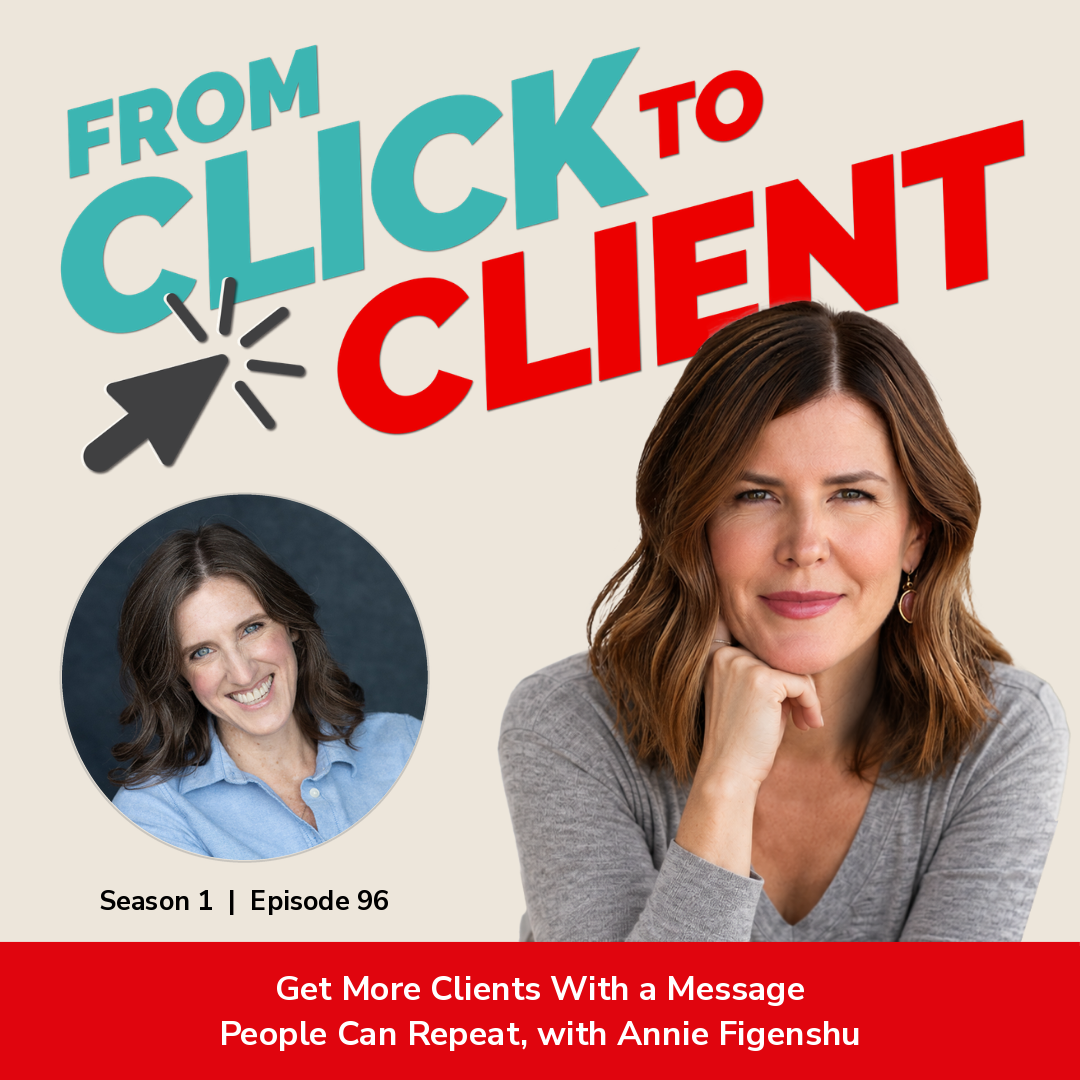
Episode 96
Get More Clients With a Message People Can Repeat, with Annie Figenshu
Loading the player…
🎧 Apple Podcasts | Spotify | YouTube
About This Episode
Most of the time, you aren't in the room when someone refers you. A friend brings you up over coffee, or a manager takes your proposal to their boss, and they have to explain what you do from memory. If your message is long or hard to say, it gets lost on the way.
In this episode, I'm talking with Annie Figenshu, owner of Downstage Media and a StoryBrand Certified Guide who spent 15 years in improv comedy. We play a marketing improv game with two common headlines, talk about listening on sales calls for your clients' exact words, and get into why your message has to be easy to say out loud if you want to get more clients through referrals.
What You'll Walk Away With
- Why hard-to-say words make your elevator pitch fall apart
- How to borrow your clients' exact words from sales calls
- The one word your discovery call button doesn't need, and what to add instead
- Why your website needs to work before you push harder on social media
Questions This Episode Answers
How do you make your business message easy for other people to share?
Build it from the words your clients use when they talk about their problems, keep it short, and swap out any word that's hard to say. If you can't remember what you're saying time and time again, other people won't be able to either, and you want people speaking on your behalf when you're not in the room.
Why can't I remember my own elevator pitch?
Often one word in it is hard to say, so your brain tries to get around it and reaches for something else. Annie asks clients which word they keep forgetting, then replaces it with an easier one based on what their audience says. Long lists of words from AI tools make the problem worse, because they're hard to hold in your head.
Should my discovery call be free?
You don't need the word "free," because nobody expects to pay for a discovery call. Add a short video that explains what happens on the call, so people know what's on the other side of the click and get a feel for your energy. Make it clear they'll get value from the call whether or not they work with you.
Should I focus on social media or my website first?
Get your website working first. Annie learned this when ads sent a crowd of parents to a small dance school's website and nobody registered, because signing up meant going in person with a paper check. Before you launch a campaign, ask yourself what happens if it works.
"If you can't remember what it is that you're saying time and time again, other people won't be able to either."
~ Annie Figenshu
Meet Annie Figenshu
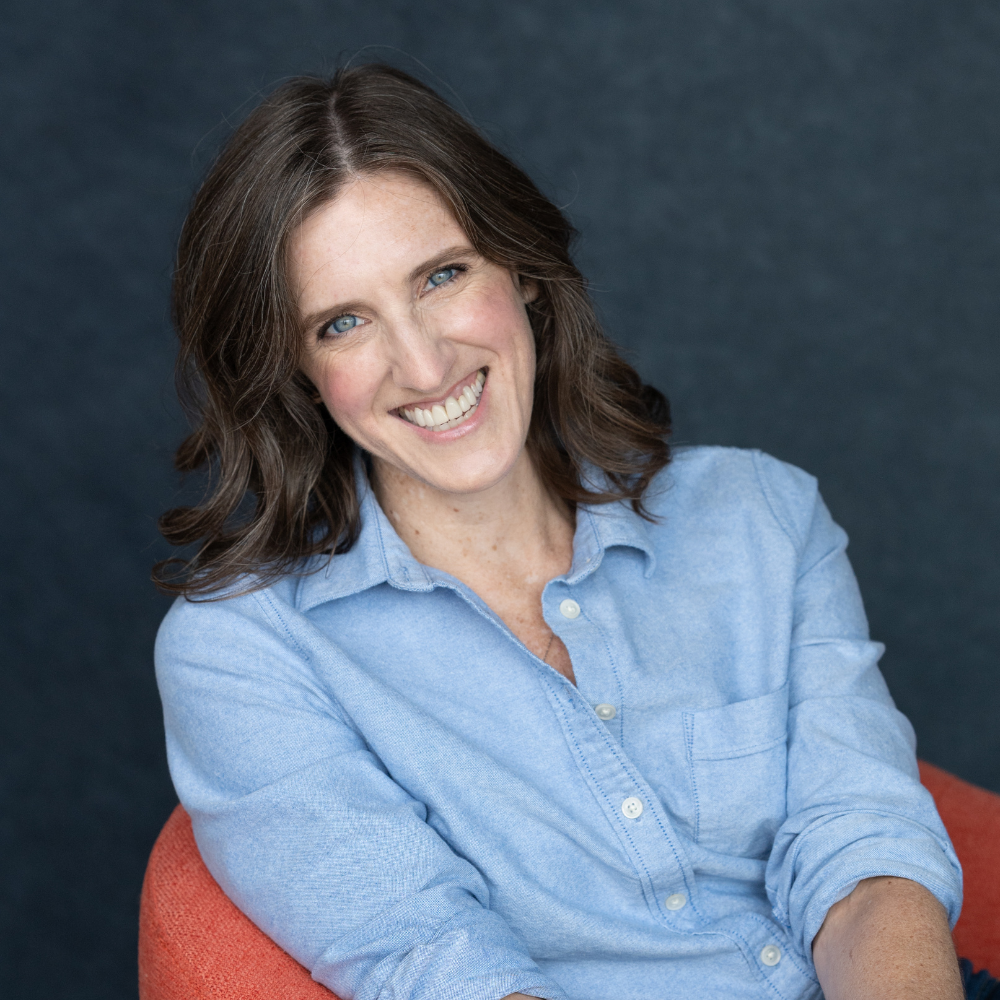
Annie Figenshu helps leadership development firms turn everything they could say into simple talking points that are easy to remember and easy to share. As Owner of Downstage Media and a StoryBrand Certified Guide, she helps firms communicate their expertise so the right companies understand why they need them and say yes sooner. She is the co-creator and co-host of The StoryBrand Guide Podcast, author of Simple Social Media, and co-author of The Content Entrepreneur.
Connect with Kris Jones

Kris Jones is the founder of Red Door Stories, a Certified StoryBrand Guide, and a messaging strategist who helps service providers, coaches, and consultants clarify their marketing message so they can attract consistent clients. Her core belief: simplicity is a strategic advantage. Less noise, clearer message, more traction.
Book a Growth Gameplan Call
Take the Free Client Attraction Scorecard
Follow on Instagram
Subscribe to Kris's YouTube Channel and Learn How to Attract More Clients
📖 Episode transcript
Improv Background
Kris: [00:00:00] Annie Figenshu, I am so happy to have you here today on From Click to Client.
Annie: [00:00:06] I'm just... I'm so excited to be here on Red Door Stories.
Kris: [00:00:09] Me too. So I would love to hear about the 15 years that you th- have spent in improv comedy, and what... how that work has informed what you do today.
Annie: [00:00:23] Yeah. I'll actually take the second question first. So 15 years as an improv comic, where I would go on stage, and I would have no idea what I was going to do, what I was going to sing, how I was going to dance. Everything was made up on the spot, and so I learned really quickly how the words that you use can affect an audience in real time. And sometimes I learned that very viscerally when they did not respond the way that I thought the audience was going to respond. and then sometimes it was just amazing, right? And I realized how important the right words can be, and- On the flip side, even if you don't have the right words, just coming up with something, right? not stopping your creativity to think "Oh, it's not good enough. Let me have a little bit more time. Let me just do it." I am able to think really quickly on my feet. And so that's the kind of stuff that I did for 15 years. I was in a show that was a very long-running show in New York City called Chicago City Limits, ironically, even though it was based in New York it has that name. And then after that, I was also in a show called Broadway's Next Hit Musical. That show still tours, and that is basically a spoof of the Tony Awards. And so then during that show, it culminates with a fully improvised 20-minute musical. And then we also would get hired a lot to be at big meetings and facilitate big meetings or emcee big meetings because we were so used to active listening and getting, off scripts, like not having to use scripts, so we would talk to salespeople. I've worked for... I've, done stuff for every single pharma company possible. But basically, like, how do you get off your sales script and really listen to the person that you're in the meeting with in order to, help that sales call go a little bit better? So all of that kind of stuff has led me to this world because when I was performing, some of the shows that I was in, one of the shows in particular, had a policy where if there were more people on stage than in the audience, the show would get canceled And we only had five people on stage, and the amount of times that the show got canceled was, like, demoralizing. And I was like, "There has to be a way that we can get more people here." And this was when there was so much more options opening, first opening up, right? With social media first beginning and blogging first beginning, and so I decided that I would just learn more, basically how to get people to the show. And so that's kinda how I came across marketing, and then it just was a way better fit for my lifestyle once I had two very young daughters, and it was hard to get to auditions and hard to get to rehearsals and things like that. Mm-hmm. So I just learned as much marketing as I could, nighttime and naptime, and that sorta led me here.
Kris: [00:03:16] Oh my gosh.I think it... When people think of improv, they think, and comedy, they think of voice and acting and being on stage, right? But I would not default to singing and dancing and having to- ... come up with songs and music and dance moves, and I think that is just next level as far as improv goes. Did you ever totally flop?
Annie: [00:03:40] Yes.
Kris: [00:03:41] In, and-
Annie: [00:03:42] Plenty of times.
Kris: [00:03:42] Yeah, I wanna hear a story of a big flop.
Annie: [00:03:45] okay. Well- well, first of all, the good thing about improv is that if you feel like you are having an off night, then you just lob things to other people who are on stage, right? Just even if you feel like you just, your brain's moving too slow, especially when I, when I had very young chil- like, babies, or like I performed up until I was eight and a half months pregnant, right? just sometimes you're just not getting enough oxygen to your brain. So if I couldn't come up with the words quickly, I would just say, "Here, guys, just somebody take the scene. I will just yes and every single thing that you do, but I really can't come up with anything." But I have had it where I wasn't singing properly, and I just... The first act of the show, I sang a song. It was the audience's favorite, so because of that, then my song was then going to be the main part of the 20-minute musical that we were going to be improvising, and somewhere between the first act and the second act, I completely lost my voice. It was really weird. I couldn't sing. I hadn't been, I guess I hadn't been properly using the technique that I have and so I just... That was awful. I hated that because it was, there was a lot of industry people in the audience and a lot of friends in the audience, and it's very intimidating, I find, to perform for my friends, for people who know me. I can perform for tens of thousands of people and it won't really spook me that much, but- Being in front of people who I feel are gonna talk to me about it later or, I don't know, I always think that they'll be like, "Oh, she talks such a big game," and I don't know. But, so I was really worried about that. So that stunk. That stunk, was that like I just wasn't able to sing for the second half of the show, and I tried and I pushed, and it just made it worse, yeah. But, in terms of other... Here's a weird thing that came up one time.
Kris: [00:05:29] Yeah.
Annie: [00:05:29] So the suggestion from the audience was horse, right? So we could start a scene, not a musical scene, but just a scene that was based on the word horse. Cool. So I go out on stage, and I'm initiating the scene, and I'm pretending as though I am... I'm miming brushing a horse, right? And I feel like I'm, like, so proud of and really, envisioning the horse there on stage. And so I'm faced towards the wings, which means that my back is to the other half of the stage, which is where my other castmates are. Then one of my castmates, he comes out to join me in the scene, and he, has his back, and he's walking backwards. And he says, "I'm sorry, doctor. I just can't seem to speak." So he was being hoarse, H-O-A-R-S-E. And I had a horse, H-O-R-S-E, and now we had to make this scene make sense. Like, why is there a horse in the doctor's office? it just made it so very difficult. So bottom line is make eye contact with your castmates- ... so that we have an idea about what's going on in the scene.
Kris: [00:06:32] Oh my God. You mentioned that you've done a lot of work with larger companies and-
Annie: [00:06:38] Mm-hmm ...
Bringing Improv Into Sales
Kris: [00:06:38] weaving improv into the sales process. And- Yeah ... the skill of actually going off script and really listening to a potential client, I wanna hear more about that. Like, how do you do that in your business when you're on a call with someone? What are some of the things that you keep in mind or that you practice to make sure that- You get them properly to the finish line. That doesn't always mean a yes, but guiding them forward and making sure you're really hearing the things that they need.
Annie: [00:07:10] Right. So it is hard, because I do feel like all of us are moving so quickly. We're trying to anticipate what the other person might say. But yes, I do like to make sure that I'm actually taking in what they're saying. I use it for a bunch of different reasons. One of those reasons is because you're going to get nuggets, turns of phrase that you might be able to use later on in your marketing, right? So for me, I work with a lot of leadership development firms or coaches or consultants, and so I wanna hear the actual words that they are using when they talk about their problems, because I wanna kinda keep that in my back pocket and pull that out for other marketing stuff that I'm gonna do later on, right? So I might write a blog post and I might throw, not even the concept, but I wanna use the exact words so that way when somebody who's in my audience is reading those words, it's like, "Oh my gosh, she's like totally in my head." So that's one of the things that I really like is so that way I can use it for that. But in a sales call then- I do think it's really powerful when people feel heard, and they know that you're not just giving them the same spiel that you've given so many other people, that it's really tailored to what it is that they need. And so I lo- I just heard this not too long ago, and it really had an impact on me, the idea of memorizing and then internalizing and then personalizing. So that idea of really knowing your work and what you offer so well, not only do you have it memorized, but it's just, you just know it by heart. And then you can really adapt it to whatever the other person is giving you, and personalize whatever that message. So I have found that's really helpful, and just people feeling heard.
Kris: [00:08:58] There's a point in my sales calls where, we've uncovered what they're struggling with, and we've walked through what they're really hoping to achieve. what would really be a win. And I say, it is just blatant. I'm like, "Okay, I'm just gonna echo back what I've heard, and then you can tell me if I've missed anything."
Annie: [00:09:16] Yeah.
Kris: [00:09:16] And it just, it's so simple, but the feedback that I've gotten from that is "I felt like you were really listening to me."
Annie: [00:09:24] Yeah. "
Kris: [00:09:25] I felt heard." And it's not hard to do. I'm jotting down a few notes as we go. But it's it always surprises me how good it feels to be on the other end of that.
Annie: [00:09:36] Yes.
Kris: [00:09:37] Yeah.
Annie: [00:09:37] And I think it's something that really cannot be Outsourced to AI. Because sure, you can absolutely take the transcript, you could put that into AI, you could say "What are some key turns of phrase? What are some things that they said? Make sure that I incorporate that into other things that I'm going to be cre-" Fine. But you can't recreate that moment of feeling heard, right? So I think it's still a skill that we all need to hone and make sure that we stay sharp with it, because I don't... Especially now, I cannot stand it when... Wait, Kris, remind me. is this podcast on video, too?
Kris: [00:10:14] Yeah.
Annie: [00:10:14] Okay, if you're listening to the podcast, I will tell you later on what I'm doing physically. But- But when you're in a, a Zoom call, and then like you just see somebody like just go like this, and you can tell that they're looking at their phone? Yeah. Right? And they're just like, like you just lo- They think that you don't know, 'cause they barely moved their head. But you can tell.
Kris: [00:10:30] Totally.
Annie: [00:10:31] And you can tell when they've opened up another window on their screen and things like that. Yeah. Right? you just lose them for a second.
Kris: [00:10:36] Yeah.
Annie: [00:10:37] And I feel like we've gotten so used to that, and there are so many times where I almost wanna do some kind of a pattern interrupt or something, to be like, Kris, here's what I..." Because I know I just lost them for a second.
Kris: [00:10:48] yo, right here.
Annie: [00:10:49] hey. Apparently that's why... I don't know if you are familiar with the '90s feminist folk icon Ani DiFranco. I don't know if you're familiar with her
Kris: [00:10:57] work. Yeah. Yep.
Annie: [00:10:58] But her guitar-playing style was so aggressive like that, partly because she would play in so many noisy clubs, and she was- Yeah just trying to get people to pay attention to her. I feel like we might need to do, we might need to figure out our Ani DiFranco version- Mm-hmm ... of how we are in calls.
Kris: [00:11:14] Yes.
Annie: [00:11:14] So that way the other person knows that "I'm here. I'm an actual person right here. Let's
Kris: [00:11:18] talk." we could do a mini workshop on that. What are some pattern interrupts that we could all go to and then infuse into common culture. We can all-
Annie: [00:11:27] Yeah ...
Kris: [00:11:27] integrate them. yeah, it is. you can see it, but it's also, an energetic thing, too. Like-
Annie: [00:11:34] Yeah ...
Kris: [00:11:34] it's just no different than when you're in person with somebody, and you're like, "You're not actually fully present right here. What's going on?" Yeah. And they're like, "I'm sorry. I'm late to another thing."
Annie: [00:11:44] Yeah.
Kris: [00:11:45] Okay. So
New Role at Babbel Box
Kris: [00:11:46] you have recently gotten a new job, which sounds really exciting, helping influencers figure out what the heck to say on social media. Is that right?
Annie: [00:11:57] No, it's the opposite. So- Oh ... brands that are trying to figure out, "How can I get more eyeballs on my product?"
Kris: [00:12:05] Yep.
Annie: [00:12:05] And so then the company that I'm working at, for, with, I gotta figure out my prepositions- ... Babbel Box, basically I say to them, "Hey, we can match your brand up with 20 different influencers- Got it ... who are all in your space, and so that way all those eyeballs that they have in their audience are now fixed on your brand."
Kris: [00:12:31] I love it. Okay. Yeah. So you're essentially gonna have a pool, a large body of influencers, or you'll, you're gonna be working with the brand and then you're gonna have that brand in mind and go out and find influencers that would be a good fit for their product.
Annie: [00:12:46] Basically, but instead of me going out and finding them, I'm gonna say to people who are on the campaign management team, "Hey, can you match up, can you go to the pool of thousands of influencers that you- are working with already and that you have relationships with and you know do really good work, and let's match it up," right? Mm-hmm. So this brand, for example, wants a, we're gonna create a box that's all about maybe, booking your 2027 travel, right? Mm-hmm. So then let's make a custom box that we could get in the hands of 20 different influencers. They can unbox it, make a video about it, and get that in front of their audience, so that way you've got all of those people talking about your brand.
Kris: [00:13:28] I
Annie: [00:13:29] know.
Kris: [00:13:29] How fun.
Annie: [00:13:29] Isn't that fun?
Kris: [00:13:30] yeah. Really fun. And so are you gonna be part of the creative to figure out, what that box is, and do you have any, communication with the actual influencer to guide that process? Or is it just we know this influencer is gonna do a great job and whatever they do is good?
Annie: [00:13:48] Yeah, I actually don't work as much with the influencers. I'll be working with the brands to figure out, "Hey, how can we... What are your goals?" Yeah. "What are you trying to do? Let's figure that out. Let's see how getting it in front of so many other people is going to put your brand in its best light," right? Yep. So that is so much then of- How we'll be doing that is figuring it out, and maybe also, what time of year makes the most sense. Yeah. what, what campaigns do you have going on? What are you launching? What's happening, right? Are you just for the first time showing up in retail stores? Well, let's get some influencers to go to the retail stores that your product is now showing up in. Mm-hmm. And let's get them to make some videos there, right? Mm-hmm. So, so many different ways to play with it, so I'm really excited about that. But I think also it's a very confusing world to many people. It's so brand new. Even though it's been around for 10 or 15 years, I'm really looking forward to making it super clear to brands, "Hey, here's how this could be an option for you. Here's how this could help you get your product or your brand in front of an audience that you probably wouldn't be able to otherwise, in a way that's trackable that you wouldn't be able to if you were to put out an ad in Vogue or something like that." So I'm really looking forward to helping break down some of it in ways that are really easy to understand and remember, and ultimately- Mm-hmm ... share with other people.
Kris: [00:15:16] Seems like a really good fit, like a fun, creative project for you.
Annie: [00:15:21] I think so. If not, I will find the fun and creativity- Yeah ... and throw it in. But, but it seems to be. I've, I'm very new there at Babble Box, but the company has absolutely been so great with welcoming me, introducing me around, giving me plenty of leeway to make things my own. And a lot of times even then I'm "Well, I don't know if I wanna make things m- you all seem to be doing very well, so I would like to just understand what things you're doing that is working." And then I'll add the Annie Figenshu elements to it- Yes ... once I get my feet wet a little bit.
Kris: [00:15:52] Real quick, if this show has helped you gain some clarity, hit follow on Apple or Spotify. It takes two seconds, and you'll get the next episode as soon as it drops. It also helps other people find the show and allows me to keep creating this helpful content for you at no charge Okay. Speaking of, Annie Figenshu fun- Yes. ... let's,
Marketing Improv Game
Kris: [00:16:14] let's play a little marketing improv game. Are you up for that?
Annie: [00:16:16] Yes.
Kris: [00:16:17] Okay.
Annie: [00:16:17] I'm 100% here for it. Okay.
Kris: [00:16:19] I'm gonna give you a boring marketing statement.
Annie: [00:16:22] Okay.
Kris: [00:16:23] And you're gonna show us how to make it interesting.
Annie: [00:16:26] Oh, okay.
Kris: [00:16:27] What do you think?
Annie: [00:16:28] Great. Sounds good. Okay.
Kris: [00:16:30] I'm gonna give you a headline, right? A very common headline. I help people reach their full potential.
Annie: [00:16:35] Okay. Give me a little bit of context. I help people reach their full potential. Cool. Yeah. What... Oh, I wish that we had, a live audience here, 'cause I would ask But, so I'm gonna ask you, Kris.
Kris: [00:16:45] Yeah. What- I'll
Annie: [00:16:45] be
Kris: [00:16:45] your yes and.
Annie: [00:16:46] Y- yes. Yeah. Okay. Yep. So what would be the ... Where is this going? on the, maybe, a LinkedIn v- bio a thing? Is that where- It- Or just answering in a
Kris: [00:16:55] networking meeting? We're ... This is gonna be a website header.
Annie: [00:16:58] Got it, okay.
Kris: [00:16:59] And this is a, a meditation coach. Oh. A mindset coach or consultant. And they're very much, they were in corporate, then they quit their day job, and they're going all in on, Joe Dispenza, manifestation, meditation. Okay. And this is their website headline.
Annie: [00:17:20] Great. Okay. So let's make it more about the other person. So I would definitely say,not so much I help you reach your full potential, but if it's in the meditation space, maybe it's something like, opening, opening your mind to a bigger world or something like that, right? Because we really wanna have a sense of where and who, and initially, opening you up to your full potential, that really could be anyone. And so we wanna have a little bit more of a sense of place in a way that people might be able to understand. So I don't know. Okay. Give me another one. Let's workshop
Kris: [00:17:59] it. Let's do another one. I'm passionate about helping entrepreneurs succeed
Annie: [00:18:04] I'm passionate about helping entrepreneurs succeed. so this sounds like something that you would say in, a networking meeting, right?
Kris: [00:18:12] yep.
Annie: [00:18:13] And so often, I think, in a networking situation, people are just trying to figure out, are you for me? I don't understand. do you have something that I might need? Because we all have different things that we're needing all the time. So I help entrepreneurs succeed. Okay. So I would probably then get a little bit more specific with the entrepreneurs, right? So let's get... 'cause that could be so many people. Nowadays, everyone's like a 1099. Nobody's a W-2 anymore. Right. so many people are basically entrepreneurs, so who is it? something that could be fun would be, I help the people who... Mm-hmm ... and then, insert whatever niche they're in, right? Mm-hmm. So I help the people who build roofs build a stronger brand, or something like that, right? Uh-huh. so I think that it... I help entrepreneurs... What else was it?
Kris: [00:18:58] Succeed.
Annie: [00:18:59] Yeah.
Kris: [00:18:59] I'm passionate about helping entrepreneurs succeed.
Annie: [00:19:02] So then the other thing is, and this goes back to what I was saying about sales calls, is what are some of the words that you're hearing other people say when they talk about, in this case, what they really want? Right? So what does success... Everybody says, "What does s- success look like?" But what does success sound like? Mm. How are they talking about it? So- Mm ... I help the people who build roofs always keep a roof over their heads, right? Something like that. Mm-hmm. Now it's telling us a little bit more of what's going on. We've got a little bit of play on words with the building and the billing, right? So there's different things that we can really play with. Okay. But I think it's just so important to... This is another thing that people don't really talk about a lot, but I do think because I have a theater background, it comes into play, which is how... In theater, we would oftentimes talk about, like,
Making Words Speakable
Annie: [00:19:50] how singable are the words. but how speakable are the words? Meaning, you don't... There are certain words in our language that are just hard to say. Right? So for example, rural, right? So if you're working with people who are not in an urban area, and you might normally be have have people who are in, a rural setting, you don't wanna use that word 'cause it's just hard to say. So I oftentimes will ask people, once we've started to figure out what their elevator pitch is, for example, right?
Kris: [00:20:20] Yeah.
Annie: [00:20:21] What are you not... And, and they'll say, "Oh, I can't remember it. There's certain words I can't remember." And then I'll say, "Okay, well what's the word that we had jotted down that you're not remembering?" And it's often because it's hard to say. Yeah. And so their brain's trying to get around it and say something else. So it's like, well, let's just find another word that we could say. Let's base it on what you're hearing from your audience. Let's see if there's a fun turn of phrase. Let's see if we can have it give us a better sense of who and a better sense of where. Let's see what we can do to adjust it. But so many times just making it easy to say will make it easy for other people to say on your behalf when you're not in the room.
Kris: [00:20:57] Which is huge, because most of the time you're not gonna be actually in the room. when people are- Yeah ... referring other people to you, or you're pitching something and they're gonna go take it to their higher-up to get approval, you're not there. So- You're not
Annie: [00:21:09] there ... it-
Kris: [00:21:10] yeah.
Annie: [00:21:10] Yeah. So all the awesome words that Claude gave you and ChatGPT gave you, and they gave you so many.
Kris: [00:21:16] So many. Long ones ... long- Yeah ...
Annie: [00:21:18] ones. Long lists. So many
Kris: [00:21:21] lists. Commas and commas.
Annie: [00:21:23] Conjunctions- Yeah ... for days.
Kris: [00:21:26] Oh.
Annie: [00:21:26] But yeah, that's the trouble. I love using AI tools, but I find it is very hard when I have to then repeat them later on. Because I've gotten so many words from it, I just can't remember. They just don't stay in my head. Yeah. So that's why I try to really figure out the brass tacks of what it is that I'm trying to say in a way that the person I'm speaking to will really be able to understand it and remember it- Right and then repeat it.
Kris: [00:21:56] Low cognitive load.
Annie: [00:21:58] Low cognitive load.
Kris: [00:21:59] there was a bit, now I'm forgetting which show it was on, but I'm gonna find it for you after-
Annie: [00:22:04] Okay ...
Kris: [00:22:04] today. but it was, there's this actress, and she is in a play called The Rural Juror.
Annie: [00:22:10] Oh. Yeah.
Kris: [00:22:12] Do you know what I'm talking about?
Annie: [00:22:13] I
Kris: [00:22:13] do. And nobody can remember the name of the show.
Annie: [00:22:16] Yeah. And then the people who can remember it can't say it.
Kris: [00:22:19] They can't say it.
Annie: [00:22:20] I do forget what that is.
Kris: [00:22:22] I can picture the actress. She's, like, blonde and... Anyway. It'll
Annie: [00:22:26] come to me. Oh, it's a 30 Rock episode.
Kris: [00:22:27] 30 Rock, yes. That's what it was. The Rural-
Annie: [00:22:30] Yeah
Kris: [00:22:30] Juror.
Annie: [00:22:32] when you read- About Stephen Sondheim coming up with the lyrics for things, about Lin-Manuel Miranda coming up with the lyrics for things. They will oftentimes talk about how if something is hard to say, it just makes it difficult to say it quickly, and both of those composers are known for having rapid fire lyrics. Think about when you've got a 20-second pitch or a 30-second pitch. one of my clients was on Shark Tank. He had 90 seconds- ... to get his pitch out there. So we're not gonna have any rural jurors. Yeah. y- we've gotta make it, the words really easy to say. Right. And I just feel like that's overlooked a lot.
Kris: [00:23:10] Okay, I have another... The rural juror just cracks me up.
Annie: [00:23:14] I
Kris: [00:23:14] know. Okay. So what would you say to a client if they were like, "Okay,
Discovery Call Best Practices
Kris: [00:23:23] my main call to action is book a free discovery call to learn more"? Is there anything wrong with that, or is that fine?
Annie: [00:23:26] Book a discovery call to learn more. I think that's fine. Here's what I would do, though, is I would probably have a little video or something that helps people understand what's on the other side of the click, or what's gonna happen in that call. Mm-hmm. Mm-hmm. I don't think that you need free, because, who's expecting to pay for a discovery call? Right. Nobody's expecting that. So just- Right ... just make it book a discovery call. So let's get rid of one word there. but I do think it is great, especially if you are in the, like, consulting, coaching, facilitation, workshop, keynote speaking. Make a video of it that's "Hey, here's what we're gonna do together in this discovery call. I'm gonna help to understand what it is that you're working through right now, how I might be able to help you. And if not, I'm gonna point you in the direction of somebody who can. So just click on the link here, so that way you can find a time on my calendar that works for you." I find that's really helpful so people start to understand a little bit more of you and your vibe. Mm-hmm. Because if they're like, "No, this girl... This Annie Figenshu girl, she uses her hands a ton. She speaks really frigging fast." I don't think I want that energy. I'm not for everyone. And I want people to know that right off the bat.
Kris: [00:24:29] Yeah, and I think the main thing is you're really asking somebody to give up their time, and they know they're potentially gonna get sold to.
Annie: [00:24:38] Yeah.
Kris: [00:24:38] And really nobody wants to do either of those things. So they have to know that they're gonna get a benefit from getting on that call, regardless of if they work with you or not.
Annie: [00:24:49] Yeah.
Kris: [00:24:49] So that whole idea of, if I can't help you... number one, maybe I can just help you on the call, no obligation. Yeah. Number two, if I can't help you, I'll definitely point you in the right direction.
Annie: [00:24:58] Yeah ...
Kris: [00:24:58] who wouldn't want that, right?
Annie: [00:25:00] Yeah.
Kris: [00:25:00] Yeah.
Annie: [00:25:00] Well, the only thing would be if somebody's like, "Can you just tell me ballpark figure of what we're talking about money-wise?" Yeah. Because I think that's the only thing that's really frustrating, why p- somebody may not want that. If they're like, "I really don't wanna have to give up 20 minutes of my day just to figure out whether or not it's in my price range."
Kris: [00:25:17] And what do you do? Do you give people a range ahead of time, or?
Annie: [00:25:20] I usually say starting at.
The 14-Day Messaging Offer
Kris: [00:25:21] Tell us a little bit about your offer. I love the name of it.
Annie: [00:25:25] Thank you.
Kris: [00:25:25] Yeah.
Annie: [00:25:26] Kris Jones and I both read the book Hundred Million Dollar Offer by Alex Hormozi, and so he talked about having a name, and I always love the idea of having... I always say, have a snappy name, because when you have... When you give something a name, it makes it a thing. So I have the 14-day know what to say messaging campaign. So over the course of 14 days, you will know exactly what to say when somebody asks you what you do for a living. You'll also know that whether it's a human being asking you that or whether it's a platform like LinkedIn asking you what you do, or whether it is another social media platform, or if you have to put it on your About page, just that idea that you would know what to say to answer the question. And we talk about finding the words that are understandable, memorable, and shareable, and also saying them. I work then on not just figuring out what those words are, but then what's your delivery- Mm ... on that, because you can emphasize certain words, and it'll have a little bit more impact. You could have a pause, and it'll have a little bit more impact. You can intonate your word at the end of the phrase, which will also have a little bit more impact than if you go down in your energy, right? So- Mm ... there's a few things like that then that I'll bring into play as well, so that way, when people are talking about whatever it is that they do, they're able to put themselves in their best light.
Kris: [00:26:42] Right. I love that you've pulled your theater background into this, because it's not just about the words. It's about, number one, practicing, memorizing, but getting coached. what a gift to get coached on exactly how to say the words that you've come up with. I think that's brilliant.
Annie: [00:27:02] I don't know. I think that
Finding Your Own Voice
Annie: [00:27:05] many of us start out trying to be like the people we admire, and we want to do it just like those people. I've got a bunch of mentors that some of them I know in real life, some of them are just mentors in my head because I've read their books or something like that.
Kris: [00:27:20] Yep.
Annie: [00:27:20] And I wanna be just like them. It reminds me of when I was in high school, and when I first saw Rent on Broadway, and I first heard the cast recording, I thought, I wanna sing like Idina Menzel. She is how I sing when I'm in my bedroom. That is how I want to sing." Yeah. And I sang just like Idina Menzel all through college, and then eventually you find your own voice, and that's kinda how this was. For about nine or 10 years now, I've been in the marketing space. I've tried to grab things from so many different people, and then I started to really figure out what makes me, me- Mm-hmm ... and what makes what I do different than what you do, Kris. And even if we've read the same books, even if we have similar mentors, even if we have a similar idea of how to go about things, we each bring our own colors into it, and I just thought, "What if I just doubled down on those things?" And it's really worked out really well.
Kris: [00:28:14] Yeah. It feels very aligned and congruent with- ... who you are.
Annie: [00:28:21] yeah- And I do wanna say, it's not just marketing speak, right? yes, it feels good, and that's gratifying, so that's enough for me to say, yes, it worked out really well. But also, taking those principles and helping my client who was on Shark Tank get a quarter of a million dollars. Yeah. And having enough of a business of enough people coming to me and then staying with me that, I've been able to, make some really nice changes in my life personally because of those sorts of things, right? So I think it's just stuff like that which just shows, yeah, this is how I know that I'm on the right track. Totally. It's not just- Yeah ... because it feels good.
Kris: [00:28:55] Somebody asked me to give a talk in their community on Monday. And- Oh. and it went really well, but I got to put together any kinda talk that I wanted. And so I've done different talks, but this one I was just... I just created the whole thing from scratch. And- I didn't know it while I was doing it, but I basically pulled in all the things that I care about and all the things that I've been doing for 20 years, and all those little things that I think... and sometimes, in StoryBrand, we can get so caught up with the words that we forget about some of the other components. And it was this, combination of is your... The theme of it was, is your brand leaking trust? Why are certain clients saying no to you when they should say yes? And it pulled together this idea of your design. Are the visuals and the way you're showing up with your logo, your colors, your brand, like, all the things that make up your brand, visually, is that in alignment with who you are?
Annie: [00:30:02]
Kris: [00:30:02] And then the second part was your story, your words, your message. Is the story, properly positioning you as the guide and your client as the hero? And then the third one was your proof. what kind of proof do you have, and is it actually properly working for you the way that it should? Yeah. transformation-based. So I... It was funny. Yesterday, I showed my partner. I was like, "Oh, this is where I landed with all of this." And I realized that I had unintentionally just pulled in all the things, like you did with helping people with their delivery, which is like using your voice as an instrument and a tool. That is not my area of expertise at all. Mm-hmm. but if you fol- if you do some things organically, or if you just ask yourself, like, "What... How can I craft this offer in a way that can, I can bring all the components of myself to it- Right ... in the ways that I can best help this client? What would that look like?" Mm-hmm. And I feel like you did that with this offer, and I feel like I did that with this talk that I did. Yeah. And it's fun. It feels good, right?
Annie: [00:31:16] It does feel good, and you realize then how other times when you're trying to be something you're not quite. Right? And you realize how uncomfortable that can feel, and then once something is right, it's, "Ah, yes." Yeah. It's when you are wearing somebody else's shoes, and you're like, "Wait, these don't fit right." Right. And then you put on yours, you're like, "Oh, yeah, these are right."
Kris: [00:31:37] Yeah. Or, well, your favorite jeans, for sure. yeah.
Marketing Mindset Shift
Kris: [00:31:40] what's something that you used to believe about marketing that you have completely changed your mind about?
Annie: [00:31:44] I used to think you had to be on social all the time. And I realize now that you probably should have some other things in place first before you amplify what you're doing on social.
Kris: [00:32:03] Okay. And what do you need in place?
Annie: [00:32:05] I do think you need to have a website that other people can easily navigate. I learned this lesson early on. It was heartbreaking. I was... It was an early client of mine. I was doing social media for the performing arts when I first started, and it was a dance school, very small dance school, local in my town. And she didn't have a lot of budget for ads, but we- she had gotten such a great following with the content that we were putting out, that when it became time to get people to register for their fall classes, she was like, "Let's run some ads, so that way more people can see it." Great. Awesome. And I looked at her website. I was like, "This isn't a great website," but, whatever. What... I don't exactly know, so I got her matched up with a friend of mine who is in social ads, and the ads did exactly what they were supposed to do. Took a whole lot of people to the website.
Kris: [00:32:57] And no one bought. No one registered for classes, because it was... Her process was tricky. you had to go to her s- dance school. you couldn't do it online, and you had to go in person, and you had to have- Oh ... a paper check. it was just all this craziness. And, young parents who were, like, in their early 30s were like, "I don't even know how to write in cursive, let alone write a check.
Annie: [00:33:18] What are you talking about?" And I felt so terrible, because I allowed this to happen. I didn't put the kibosh on it right off the bat and say, "Look, this is not the best use of your marketing dollars." "You should not do this. Let's do something else first before you do it." And so that I keep in mind all the time of how important it is. You have to imagine, what if this thing that you, this campaign, what if it works?
Kris: [00:33:44] Right.
Annie: [00:33:45] Then what happens?
Kris: [00:33:46] Oh, it's so true. I talk a lot about, your website as the center of your marketing universe, and there are planets that are circling around that sun. Each of those planets is a marketing activity, whether it's, networking event, or ads. Any kind of marketing activity, point people to the website, right? Yeah. Yes. You never want to hang out on any planet before you've got your sun dialed in. I love
Annie: [00:34:10] that.
Kris: [00:34:11] Yeah. Lovely. Do you- Okay.
Annie: [00:34:13] Yeah. Wait. Have you created things around that?
Kris: [00:34:14] I have an infographic around that, but I should lead with it probably more often.
Annie: [00:34:20] I love it. Yeah. It's such a great visual.
Kris: [00:34:22] Yeah, it really is. And your only job, pick two planets. Don't do more than two planets. Like-
Annie: [00:34:27] Yeah ...
Kris: [00:34:28] hang out on two planets. My planets are podcasting and email marketing. Mm-hmm. And when I hang out on those planets, I just point people to my website, knowing it is doing the job of selling for me.
Annie: [00:34:39] Yeah. Yeah.
Kris: [00:34:40] So yeah. It's a good way to think
Annie: [00:34:42] about it. You're just orbiting the sun.
Kris: [00:34:43] Orbiting the sun. Yep. Pointing people back to the sun. okay. Do you
Annie: [00:34:47] do special things on eclipses? is there anything... Oh, I guess that would be the sun and the moon. Yeah. That'd be a little different.
Kris: [00:34:53] No. I'm not, into astrology.
Annie: [00:34:56] Yeah.
Kris: [00:34:56] But I am open to the woo-woo, and I was thinking about bringing my animal spirit cards to the guide retreat to do some- Wow ... readings. Would you like me to do that?
Annie: [00:35:08] Yeah. Duh. Okay. I'm so into it.
Kris: [00:35:11] Okay.
Annie: [00:35:11] I don't know... I don't feel as though I've... First of all, I know for a fact I've never had an animal spirit reading.
Kris: [00:35:17] Okay.
Annie: [00:35:18] And I love it. yeah, I'm in. I'm so in.
Kris: [00:35:21] Okay. I'll bring 'em. We'll do a reading. all right. W- I-
Final Takeaway & Where to Find Annie
Kris: [00:35:30] is there anything you would like to, any kind of wisdom that you would like to share? What's, one little takeaway that you could give our listeners today, and then where can we find you?
Annie: [00:35:35] The takeaway is that if you can't remember what it is that you're saying time and time again, other people won't be able to either. And you want people speaking on your behalf. So make sure to make it really easy for them to share it. And the best place to find me is you can go to downstage.media, and that's where you can schedule a call with me. I have a lot of different events. I have book club that I do once a month, where we read a book and then we talk about it rapid fire. And for local marketers in New Jersey, I host a marketing Algonquin once a quarter, where we sit and talk shop. And there's all kinds of things that are happening, but yes, go to downstage.media- ... and you'll be able to find more. I'd love to hear from anyone who's listened to this, and, find out what you're up to.
Kris: [00:36:29] Yes. And the book club is free. Totally
Annie: [00:36:31] free.
Kris: [00:36:32] I've read a book with Annie. I learned a ton, got to meet some new people. Yeah. So I highly encourage you to do that. That's a lot of fun,
Annie: [00:36:39] yeah. In December, we're reading, Groundswell by Scott A. Martin. It's all about, branding and building your business that way, the unseen wave of business growth. what are those things- Hmm ... that you could be doing-
Kris: [00:36:49] Okay ...
Annie: [00:36:50] in order to build your business, so.
Kris: [00:36:51] I'm gonna
Annie: [00:36:51] sign
Kris: [00:36:52] up for that.
Annie: [00:36:52] Yeah. So it's a good one. And it's in December, the beginning of December, so you have a little bit more time.
Kris: [00:36:56] Perfect. Annie, it's been such a delight to have you here today.
Annie: [00:36:59] Kris, it always makes me happy to be near you.
Kris: [00:37:02] Thank you so much.
Annie: [00:37:03] Thank you.
Kris: [00:37:04] And thanks for listening.


Brand & Growth Strategy for Experts Who Want to Stand Out
© 2026 Red Door Stories. All Rights Reserved.
Privacy Policy. Terms of Service. Disclaimer. StoryBrand Website Design by Red Door Stories