From Click to Client Podcast · Episode 90
The Brand Story You're Afraid to Tell Could Grow Your Business
How to bring a hard personal story into your brand without oversharing, and why owning it can change your business.
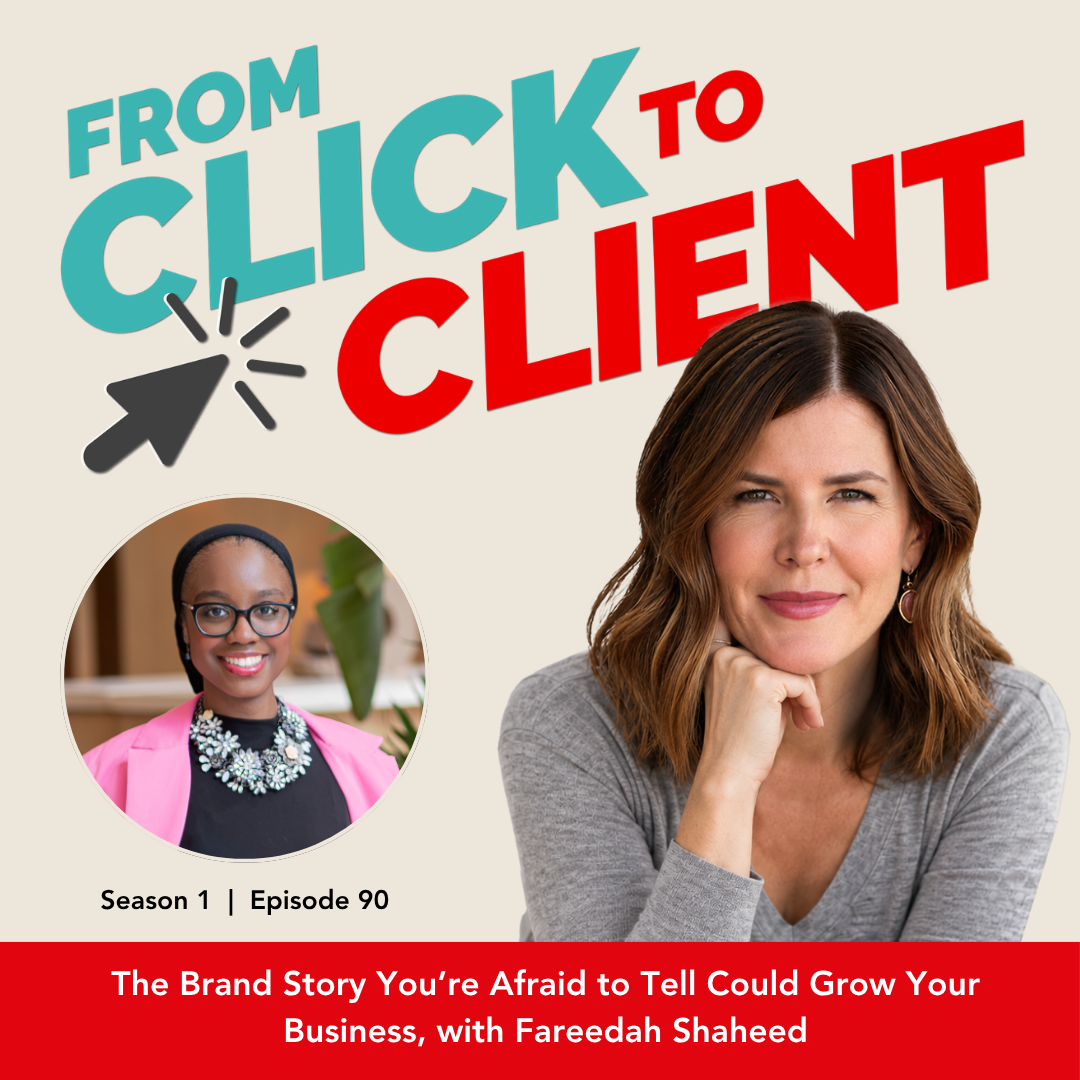
Episode 90
The Brand Story You're Afraid to Tell Could Grow Your Business, with Fareedah Shaheed
Loading the player…
🎧 Apple Podcasts | Spotify | YouTube
About This Episode
Your brand story might be hiding in the part of your life you've been afraid to talk about. For Fareedah Shaheed, that part was being groomed online as a kid. It's the reason she now helps parents protect their children from online predators, and for about 10 years, almost nobody in her professional world knew it.
In this episode, I talk with Fareedah, a Forbes 30 Under 30 internet safety expert who has worked with organizations like NASA, Meta, and FedEx. She shares what happened when she finally started telling her story, how she decides what to share and what to keep private, and how to turn a hard story into an empowered one. We also get into a question a lot of business owners wrestle with: whether to post your kids online as part of your personal branding.
If there's a story you've been keeping out of your marketing, this conversation will help you figure out why, and what to do about it.
What You'll Walk Away With
- Why Fareedah kept the reason behind her business quiet for a decade, and what changed the day she said it out loud
- The first question to ask yourself before you share a hard story in your marketing
- A middle ground on posting your kids online that goes further than "just don't"
- The early morning habit Fareedah says makes her feel like she has 72 hours in one day
Questions This Episode Answers
How do you use a hard personal story in your brand story?
Start by figuring out why you're afraid to use it, because that fear tells you what the next step is. Fareedah Shaheed kept the reason behind her business quiet for about 10 years, and she says owning it has had an impact on her business she can't fully put into words. Once she shared it, people who had known her for years finally understood why she's so passionate about her work.
How do you share a difficult story without oversharing?
Fareedah doesn't believe in being vulnerable just for the sake of being vulnerable, especially as a woman online, where you can become a target. She recommends working through the story first with people you trust, like a therapist, a coach, friends, or family. That way you share it in a way that benefits you and your family instead of putting you in harm's way.
Should business owners post their kids on social media?
Fareedah's view is that the safest choice is not to post your kids, but she doesn't agree that posting makes you a horrible parent. You can share your parenting experience without showing their faces or exposing their identity, private thoughts, or what they're going through. Ask yourself whether you'd be okay with your child using your posts as their model of what a safe person shares.
How do you turn a victim story into an empowered one?
For Fareedah, it took a lot of inner work: therapy, meditation, journaling, and ongoing conversations with her inner child. She says nothing works until you feel safe with yourself, because pushing through fear without that can lead you to sabotage what you want. Owning the story also means you tell it from your point of view, instead of leaving it for someone else to tell.
"I don't believe in exposing yourself and being vulnerable just for the sake of being vulnerable."
Fareedah Shaheed
Meet Fareedah Shaheed

After being groomed online as a child, Fareedah Shaheed made it her mission to help parents protect their children from online predators. Today, she's a Forbes 30 Under 30 Internet Safety Expert known for her signature SAFE Method, which makes digital safety easy and accessible in the age of AI. Fareedah has also been named a LinkedIn Top Voice in Cybersecurity.
Visit Fareedah's Website
Join the Protect Kids Online Membership
Get the Protect Kids Online Resource Library
Follow on Instagram
Connect on LinkedIn
Subscribe on YouTube
Follow on TikTok
Connect with Kris Jones

Kris Jones is the founder of Red Door Stories, a Certified StoryBrand Guide, and a messaging strategist who helps service providers, coaches, and consultants clarify their marketing message so they can attract consistent clients. Her core belief: simplicity is a strategic advantage. Less noise, clearer message, more traction.
Book a Growth Gameplan Call
Take the Free Client Attraction Scorecard
Follow on Instagram
Subscribe to Kris's YouTube Channel and Learn How to Attract More Clients
📖 Episode transcript
Kris: [00:00:00] Today's guest is Fareedah Shaheed, and she was actually groomed online as a child, and then she turned that story into a business, and it's very much aligned with her purpose and reason for being on this planet. Now she is a Forbes 30 Under 30 internet safety expert. We're gonna talk about how she built a business on a hard story, and we're gonna get into how she turned that story into a framework, and then we'll cover what all of us should know about keeping our families safe online. Fareedah, thank you so much for being here. I cannot wait to get into this with you.
Fareedah: [00:00:40] Thank you for having me, Kris. I appreciate you.
Kris: [00:00:43] Yeah. Tell us a, tell us, like, the short version of your story.
Fareedah: [00:00:47] Well, short version is that I did every single thing my parents told me not to do online. Don't talk to strangers, don't send information, don't send pictures, don't download that game, don't spend so much time online. Everything they said not to do, I did. I lived a double life. On the surface, I was like the good kid, followed all the rules, was the class president in middle school, got good grades, relatively. C's get degrees. and, and so I was really good. I was the teacher's pet. People loved me, but then I had a double life, and eventually one of the guys I was talking to as a kid, I... This was like s- a couple years into my double life, so I was 16. I decided that I was gonna meet him in person, 'cause we had been talking about that for a while. I knew my mom would be upset, so I said, "You know what? I'm moving in." He already was hinting at me moving in. He wanted me to move in. He was like, "Hey, you can move in. I have space for you. I'm a single guy." He was in his 40s, ex-military, just got out of, you know, duty. So he's like, "Yep, I have a space for you." And so I was thinking, great, like, what better person to be with, an older adult who was in the military? I'm completely safe. And so I knock on my mom's door and I say, "Hey, like, I'm gonna meet this guy. I'm gonna move in with him, and I just wanted to let you know." I wasn't gonna tell her, but I'm her only child, so I thought, let me at least let her know where I'm going in case, I don't know, she needs to know. But I wasn't really asking for permission. So I genuinely thought that she would lose her mind. She never did growing up. She never yelled, never screamed, never even slammed the door. But I knew that this would be the moment, and she didn't. And so that's what kept me put for those couple of minutes that turned into three to four hours where we talked, and I stayed home that day, and I ended up not talking to him, and I ended up not meeting him, and it changed the course of my life. And that's what I do today, is helping parents connect with their kids, understand their double life, and prevent them from needing to run away or from trusting a predator more than they trust their parents.
Kris: [00:02:37] Oh my gosh, what a pivotal moment. And in hindsight, how wise of your mother to not freak out on you and to really engage in a conversation. How did this guy initially reach out to you, connect with you?
Fareedah: [00:02:55] We were playing an online game together, and so we had a lot of interests. So he probably... I can't remember exactly, 'cause there were so many. This is just one. Every time I tell this story, people think, "Oh, it's just one guy." I'm like, "No." There's the one that was arrested by the FBI 'cause they saw it in, in his laptop, and then there's another one. There's so many. Because when you're living your life, I want people to think about our lives as adults. We go to the grocery store, we go to work, we go maybe work out, a, a bunch of things you do for your business, for your life. How many people do you meet, and how many people do you say hi to? How many people do you interact with? How many people do you give your business cards? How many people do you go to lunch with? It's the same exact thing when a child is in the online space. They're not just interacting with their friends, they're interacting with the whole online world. So when they're on YouTube, they're seeing their favorite creator, and they make comments. Someone might see that comment. They might go back and... So there's so many different ways you can meet people. So there are so many different people who are good, bad, ugly, and beautiful, and the ugly and bad people were typically, that was the predators, and then other people who are bullies or people who just didn't mean well. They're just annoying human being. And then there were just, like, some good regular people who were just going about their life. They're just playing this game. They're just on social media. And there's some beautiful people that I'm still connected to to this day. We went through marriages, miscarriages, divorces, moving countries, getting a new career, a new job, the whole nine yards.
Kris: [00:04:09] Wow. And how old were you, again, when you had that conversation with your mom?
Fareedah: [00:04:16] I was 16, so I thought I was grown, of course.
Kris: [00:04:18] Right. You knew everything.
Fareedah: [00:04:20] Of course.
Kris: [00:04:22] And then you cut things off with him and then continued into high school and graduated, yeah?
Fareedah: [00:04:28] Yes. Yes.
Kris: [00:04:29] Okay. And then what happened after that?
Fareedah: [00:04:31] Um, I was still in the online space, online gaming, but I, at that point, I trusted my mom more, so I wasn't necessarily having a double life. I was just telling her who I was talking to. She never was a parent that was like cut everything off. If she did, I'm hardhead- hard-headed, I would've left, 1000%. We all know that in the family. I'm too hard-headed. But so I continued that, graduated high school, went into college for cybersecurity and IT. Um, loved that. Got a job in cybersecurity and threat intelligence. Did not think anything of my whole experience. I buried that 10,000 layers deep, never to be thought of again. And then while I was in the job, um, if anyone's familiar with working with people in IT and security, a lot of people, the rumors are true, they hate humans. They don't like people. And so every day everyone's grumbling, "Oh, I hate humans. Oh, my God, I have to talk to a person." The worst thing. And so, and it's not even the introvert way. It's like genuinely hate hu- people. And so I was the only person on the team that didn't hate people. I loved them. I was like, "I love people." Do I need my alone time? Do I love being alone? Yes, I love being in my four walls, and I love people. And so I was a person that would go out and talk to people, and naturally, most people in corporate are parents. And so they would look at me, I was like 19, maybe 20 at that time, and they thought, "Who are you?" Like, "He looks way too young." I still look very young. And so they were thinking, "Okay, you're talking about cybersecurity in the workplace and all of that, but, like, I don't really care about the workplace. I just do what they say 'cause, to keep my job. But I care about my kids that's on Roblox." And so that's where everything began.
Kris: [00:05:59] Okay, and then so you got feedback and nudges from the people that you were working with that maybe you should move into a new role as a self-employed person? Is that when you started doing that kind of work?
Fareedah: [00:06:14] Yes. They would invite me to their, like, religious communities, churches, synagogues, mosques, the PTA meetings, all of that, summer camp. And so from that, people are like, "Oh, well, can you do this?" And then it started being more like paid opportunities, and people were thinking, "You probably should start your business." And I was raised by a mother who was an entrepreneur, who loved business. It always felt like women needed to own businesses and make their own money, and so she was always kind of whispering in my ear like, "Well, that idea could be a great business idea." So
Kris: [00:06:45] And now you're in, you're one of the Forbes 30 Under 30. What, what does that mean, and how did that happen?
Fareedah: [00:06:53] Ooh, a- again, women in business. Love them so much. I love us. I started my business, was on Instagram. I connected with a lot of people who loved my work, and so it was a friend of mine who was nominating herself for Forbes, which I didn't even know you could, and she said, "Well, you should nominate yourself." And I was like, "I can do that? That feels a little bit weird to do that." She's like, "No, you have to do it." And so I said, "Okay, you know what? Let me do that." And so I nominated myself, and then I told other people, uh, with her advice to, like, "If you love my work over the last couple of years and you think I should be on the list, just nominate me." And, uh, so many moms, hundreds of moms came out and nominated me. And then someone on the Forbes, I don't know, it was like executive team or something, said that they'd been hear- hearing about me, and they messaged me late at night on LinkedIn and Twitter and one other place. Maybe sent me an email and said, "Can you, like, fill out this form?" And I thought it was a scam, but I thought, "Well, it's a Google Docs form. Like, what's, what's the worst that can happen?"
Kris: [00:07:46] Well, congratulations. Thank you. That's, that's incredible.
Fareedah: [00:07:50] Thank you.
Kris: [00:07:51] So tell me how, how has, like, telling your story helped you grow the business in a, in an efficient and effective way? And how do you tell your story? I mean, there's probably a lot of layers to it that are hard to talk about or hard to share. how do you navigate that?
Fareedah: [00:08:17] Well, I've been doing this now, I think it's like 10 years, and I think this is the first year that I've fully embraced my story. So I would say it took me, like, a, you know, a considerable amount of time to actually lean into the story. I've said it before, I've said it in passing. I was slowly starting to say it a couple years ago, but this is the first year that I go up to people in conferences and I say, like, "Hi, you know, I was groomed online as a kid, and now I help moms protect their kids from online predators." That's insane. Absolute madness. I would have never thought I would do that. But I was at a conference, um, April, Frank's conference, and Shalene Johnson was speaking, and Shalene had known me for a couple of years, and she told, like, "You need to be able to relate to your audience. You need to be posting things that make sense to them." And I got up there and I said, "Shalene, like, I, how can I relate to moms when I'm not a mom and I don't intend to be a mom?" And then she looked at me and she was like, "Well, you're talking about something that all moms care about, so that's the relatability factor." And then she said, "Also, I've don't know why you started your business." And then she asked everyone in the room had, who had been with me, 'cause this conference are full of people who I've connected with for the last couple of years, online and offline. And she said, "Does anyone else know why Fareedah does what she does?" And everyone was like, "No." And a couple people were like, "Well, I think she worked in cybersecurity and that's why she cares, and, you know, kids, everyone cares about kids, so maybe that's why." And then she was like, "Can you tell the room why you did it?" And I was like, "Oh, I was groomed online." And then everyone was shocked. They had known me for all of this time, and no one knew that. And they were like, "Why don't you ever talk about that? 'Cause that's why you're so passionate about it." So to be honest, I will have to say that it took me a very long time to fully own it. It was of April of this year that I'm fully owning it, and the impact that it's had on my business is insurmountable. I can't even begin.
Kris: [00:09:59] Isn't it funny how what happens to us as children, the wounds, the, the challenges that we end up making that our lives work often, and but we often don't make the connection or don't connect the dots. So like, you're in cybersecurity. It never occurred to you that you went into that field- Never ... after being groomed? It's just- Never ... it's... I've heard a handful of people talk about this, and it's such an aha moment, and it's such a fun question to ask yourself, like what do you feel so passionate about, and where did that initially come from? For example, there's a, nonprofit called Charity Water, and they provide fresh water to villages in Africa that don't have fresh water. And the guy who founded it, it wasn't until... Like, he's been doing this 20 years. It wasn't until a few years ago that he was working with somebody on giving a talk, and that person Asked him a bunch of questions, and he talked about his childhood and how his mother had been chronically ill, to the point where she actually had to live in their bathroom because it was, like, a bunch of hard surfaces that they could keep clean and germ-free. And so he lived his life trying to protect his mom and keep her healthy and safe. And now what he does is that exact same thing, but for children in Africa who get diseases and all kinds of illnesses because of dirty water. He gives them clean water, and it never occurred to him until a few years ago when somebody, flat out just said, "There's a connection here." and it's really, really incredible. Wow.
Fareedah: [00:12:01] You don't think about it. Uh, 'cause I thought, I've always loved technology, and I've always... I would lie awake at night and think like, "How does the Wi-Fi work, and how does that work?" My dad was in tech. He was in IT. He was in security. Um, and so for me, I s- I grew up with Cisco books, so I'd be reading them and looking through them. And so I always thought that that's where it came from, and I didn't realize my pull was that I really wanted people to be safe. I grew up in a different, like, continent, not even country. Um, since my dad worked in IT and cybersecurity, he would work for, like, the American military, and we were, we're out in, like, Saudi Arabia, in Riyadh, Saudi Arabia. And so I was living in, in a military compound. I was in different country, continent, different language, and so I had to figure out ways to be confident and be safe, and this, there was a lot of bullying that was happening in school. So a lot of people had to stand up for me, and I had to figure out how to stand up for myself. And so there's a lot of that, and when I f- at years into building the business, that's when I made the connection of, oh, you've always wanted safe spaces for everyone to be themselves, to be joyful. And when I say safe space, I don't mean that everyone's always gonna feel safe in every space or even feel safe with me. I think that's the number one thing of safety is that everyone's threshold of safety or who they find safe is gonna be different. And so I'm not gonna be safe for everyone. Everyone's not gonna be safe for me, but doesn't mean that we can't create our own individual safe spaces and celebrate everyone else and everyone's nuances. And so it's only till now that I realize, oh my God, every, every single thing's coming together.
Kris: [00:13:31] That's, that's incredible. So you have, you had started, going in and just volunteering your time, helping parents, getting in front of groups, and following the requests that people were asking you to come join. And then from that, you started working with parents and consulting, and then you've also worked with larger organizations like NASA, Meta, FedEx. Tell me how that came into play.
Fareedah: [00:14:04] Those came, the, a lot of it was organically. And I would say posting online. Posting online is the biggest, I mean, that was the best decision I've ever made, and other people forced me to make, 'cause I did not wanna create content. But I've always loved the camera in some aspect, and I don't know why, but I didn't wanna get in front of it. But I lo- I was drawn to it, but I didn't feel like I should, nor did I want to, because I wanted to be alone, and I didn't wanna be perceived. So it was really interesting, because I loved it for myself, but I didn't like for other people to be involved. And so that was a very interesting way to get into content creation, because you have to do it for your business. But really, it was all business. It was all posting online, posting on LinkedIn, Facebook, Instagram, Twitter, email lists, meeting people. And they would reach out, and they would say, "Hey," like, "we have a campaign to get in front of more parents. Can you help amplify it?" So when you're posting a lot online, they want you to do that. Or, "Can you consult on this?" Or, "Can you do a workshop internally for our employees on how to stay safe at work, and then how to stay safe at home?" And it, they're more likely to come to a workshop about how to protect your kids online and stay safe at work than it is to be like, "Don't click on a link," how to stay safe at work.
Kris: [00:15:15] yeah. you've got a double whammy of benefits that way.
Fareedah: [00:15:19] Yes.
Kris: [00:15:19] So speaking of, for our listeners that have children, what do you recommend we do, and how did you turn your life's experience into a framework that you help people follow?
Fareedah: [00:15:37] I had to go back to my experiences and put everything, like with puzzle pieces. And so I thought about what I wanted to know as a kid, what I wish my parents did, and then I talked to my parents. And I was talking to my mother, and I asked her, "Okay, what made you not react in that moment? There's a lot of things." She was like, "Oh, I was not perfect. I felt like my life was over as a mom, and I messed up, and I was the worst mom in the world." And she was like, "Well, clearly all the things I've been doing to keep you safe has not been working, so let me try something new." And then she was thinking, 'I I wish that more people listened to me in my teens and they weren't trying to tell me what to do, that they listened to my perspective.' And so she was like, 'Let me do what I wanted, that, what I wanted as a teen, let me do that for you.' And then I was thinking about, like, the actual things that we go through online as kids, and things that parents don't understand, and the, well, the reason why I wasn't talking to my parents, the reason why when someone was doing something inappropriate to me as a kid online, I did not tell them, even though my parents were like, "You can tell us anything, and we love you so much, and you can whatever." Like, all parents do that, but not a lot of kids will talk to you. And so I thought, okay, what, what's preventing kids from opening up? And when they open up, what's preventing them from opening up even more? So I just went deep dive into all of that, and I put everything together, and then I, that's how the SAFE method came about. 'Cause I was tired of people talking about protecting kids online from a lab coat point of view. We need lab coats. I love lab coats. I collaborate with lab coats. Sorry to navy all's lab coats. I love it. At the same time, it feels so dehumanizing as a kid. It feels, you feels like you're a rat in a lab- Mm and I hate it. And so that's why I created the SAFE method.
Kris: [00:17:15] I love it. Real quick, if this show has helped you gain some clarity, hit follow on Apple or Spotify. It takes two seconds, and you'll get the next episode as soon as it drops. It also helps other people find the show and allows me to keep creating this helpful content for you at no charge before I get into this next question- Tell us a little bit about, like as entrepreneurs and business owners and coaches and consultants, like part of, the way we show up online often involves taking photos of what we're doing, the vacation that we're taking, who we're with, and often we're with our children. So how do you feel about including photos of your children in your posts?
Fareedah: [00:18:06] I have so many nuanced point of views on this. I think I'm gonna do a whole series of me workshopping my thoughts with other people, 'cause I truly believe that we need a community conversation with this one. I believe the conversation has been flattened to just be, "Do not post pictures of your kids online. You're a horrible parent if you do," which I understand the point of view, however, I don't agree. I do believe the best course of action is not to post yourself, one, and then also definitely not your kids online. It's just best course of action. However, you can post about your motherhood journey or what you're doing with kids without exposing their identity or their intimate thoughts and feelings and details and sickness and things that they're going through and all of that, to keep certain things private. Because you want to model for your kids what you want your kids to understand to be normal and safe, that a safe person would do. So if they think it's totally safe for a person to expose my inner thoughts and feelings and the things that I'm going through, how are they gonna figure out who's a predator or not? How are they gonna know what's safe or not? How do they know what to keep private online or not when you're not keeping that private? So you always have to look at what you're doing as if my child uses that as a model as, of a safe person and what to expect from their friends and what they can do to their friends, will I be okay with that? Will this increase my child's safety with me internally and externally, mentally, emotionally, all of that, spiritually, or will it not? Then that's when you get the answer. Your gut feeling will tell you the answer of exactly how to approach it. Maybe you share your kids, but you don't share their face. Maybe you share, different parts of their story as it connects to your story, but not things that they, that are personal to them that they would never say. So you can say what you ha- okay, you have a kid that's autistic, so what do you do, you do as a parent instead of going through detailed stories about what they're going through.
Kris: [00:19:51] Got it. I love that so much because- Really what you're getting at is that you don't have to look externally for the right or wrong answer. You need to really understand what's going on, and then tune into your own gut and follow what's right for you.
Fareedah: [00:20:11] Right, because we have the power, and the conversations we're having externally, and I don't wanna get too long in this 'cause I know we have to wrap up, but we're putting so much power externally, and we're always like, "Well, if you do this, then that means this will happen, and if this bad thing happens, then your life is over and your child's life is over." And I put this online, and it's very challenging for us to talk about, but if we talk about the worst-case scenario as if someone's life is over, and then we can't be surprised when a teen feels like their life is over and they shouldn't be here anymore. And so we have to change the conversation to power internally so that no matter what happens, whether you post your kids or not, whether you post this or not, that you have the power to decide what storyline you're gonna tell yourself for the rest of your life. Because kids' photos are being exploited, when parents are never posting anything online. And so what do you say to them? W- how do we even go about this? And so I believe a powerful conversation is always gonna be more impactful than something that's disempowering you because who does that serve?
Kris: [00:21:11] Right. So if somebody is sitting on a difficult story like the one that you had for many years, and took you a decade really to come out and start talking about it, and you've got it down, like ... I love the clarity that you have and the way you tell yours. if someone is sitting on a really powerful story or a hard story and they're afraid to use it, what would be the first step they could take?
Fareedah: [00:21:40] I would go into why you're afraid to use it, 'cause then that'll inform what the next step is. So for me, my biggest fear was that I was exposing myself, and that the people that I talked to would expose me even further, or they would, they would expose me. I think that was my big fear. Secondly, that it would make my parents feel like they were not good parents, and people to see them as horrible parents. I think those are the two number one.
Kris: [00:22:06] Yeah.
Fareedah: [00:22:07] And then there's many, but those are my biggest fears. So I had to figure out, I had to do an empowering story in terms of it's better for you to own the story and tell it from your point of view, and someone else can tell it from their own point of view, from a predator's point of view, right? And so for me, that was good. And then also talking to my parents about it, sometimes not in great detail, sometimes a little bit, and having very supportive parents. Because sometimes you don't have that. So I'm very privileged, extraordinarily privileged beyond belief to have parents that are extraordinarily supportive, and that's why I feel as though I turned out to be better than I thought I could be because of their support. So I would say why you're scared of it, and from there you can work through it with a therapist, with a licensed professional, with a life coach, with friends, with family members, people who love you, people who support you, with a business coach. I would talk about that with many different people that you trust and love, and love and trust you, or that you look up to, and see what they think and help you guide you into a way that helps empower you, instead of you just exposing yourself. 'Cause I don't believe in exposing yourself and being vulnerable just for the sake of being vulnerable. Especially if you're a woman online, you're like a big target, and so you wanna use your story in a way that's actually beneficial to you and your family, and it's not putting you in more harm's way.
Kris: [00:23:25] You mentioned that to really intentionally change the narrative so it's more empowering to you, how do you do that with a story that might be more victimy or might be more- challenging or, uh, how do you intentionally take a, a victim's story and change it to a more empowered story? How do you take a victim story and turn it into an empowered story?
Fareedah: [00:23:53] Lots of therapy. That's one. Two, lots of meditation, lots of talking to your inner child, lots of holding your inner child, lots of constant communication with your inner child, your present self, your higher self, and then the highest, the highest whatever. What, your creator, the creat- Whatever you wanna call it whatever, whatever you wanna call it. Yeah. I- it's a communication between all of it, and consistent basis all the time. So I would say that, lots of inner work. yeah, 'cause I, I realize I would never do something to harm her, and so, so long as she knows that. So if I'm afraid, that means she thinks I'm doing something to harm her And so even if I were to push through that fear, ultimately I'm gonna sabotage myself because I think I'm harming myself, so I internally I think I'm doing something good, but externally I'm sabotaging what I actually want. So nothing matters until you feel safe with you and all versions of yourself, and whatever you believe is above everything else. And so that took a lot, and a lot of journaling, a lot of everything, everything you can think of, self-care- ... all of the stuff we talk about, the woo-woo, the wah-wah, whatever. Took all that.
Kris: [00:25:04] Yeah, 'cause if you do push through, right, if like I've, I've done this in the past where I'm like, "I'm gonna be brave, I'm gonna be courageous, I'm gonna push through the fear," but then I've just fractured my relationship with my little me who's scared to death. And that, in that situation it's not the best move to push through.
Fareedah: [00:25:29] Never. I always, if I'm pushing through something, it's while holding my inner child and being the parent. 'Cause you're like, you're parenting yourself again, so sometimes your kid is not gonna wanna do something that's actually good for them. And there are times where you're just gonna have to push them off the train track and then explain to them later why you had to push them and why they have a bruise, right? Yeah. There are moments where you're just gonna have to like, "Okay, we're gonna have to go." However, 99% of the time we're not in that experience where we're being chased by a lion or, a train track is in front of us. Sometimes it feels like that, but we're not in that circumstance. So 99.9% of the time you can take the time. It just takes time and effort that we don't wanna take because we, quote-unquote, don't have time. And we don't have time, but we can make time, and so we have to decide, okay, what's more important? You know, can I scroll on Instagram for 20 more minutes or 30 more minutes, or could I maybe, once the kids are asleep and they're good, maybe I can take, you know, 30 minutes or something and I can sit with myself and journal and think about that. So yeah, it took me that, just hold her and be like, "I'm going through this with you, and I'm gonna make sure you're safe and you're gonna be loved." Like, literally saying that. I'm not saying that the idea, no, you're actually saying that. You're like, "No, I'm not gonna do something that's not good for you. I know you're scared because you felt like this. And you know what? You're right. It does feel really, really scary, and I'm so sorry you feel that way. I'm so sorry that people have let you down or you felt like the world let you down or I let you down, but I'm never gonna let you down. And you want this. You always said you wanted that, and I want that for you as well. And so this is how we get there. And so I know that this feels un..." All, the whole thing, exactly like you're talking to a child. Literally talk to yourself same exact way. You can do it in front of a mirror. You can do it just closing your eyes and talking to yourself out loud. It could be not out loud, it can be in a journal. You can be walking and saying that. All of the things.
Kris: [00:27:10] Yep, 100%. I'm all about it. Like, I, I do that work actively. I should do it more often. I think having that ongoing open dialogue is really powerful. okay, as we wrap up today, I, I love that we got to get into some of the woo-woo parts- ... of how you've navigated your healing journey. what, what's, um, what's one modality or one thing you've done that's not meditation or kinda more well-known that, that has really moved the needle for you in your healing?
Fareedah: [00:27:53] Waking up before the sun sets. I think that's normal, though. I think that's very, most people do that. But I would say doing a lot of the hardest work during that time.
Kris: [00:28:03] and hard work like what?
Fareedah: [00:28:05] Internal hard work or external hard work. So things that you- Ah ... need to do in your business that you don't wanna do, I'm like, "Okay, that means my inner child is rebelling." And so the best way to sit with your inner child is before everyone is awake, because everyone else, there's so much noise. So if there's so much resistance, then she needs a moment.
Kris: [00:28:24] Right.
Fareedah: [00:28:24] So let's give her that moment. Let's, let's give her that love, and then go through that action I need to do during that time. So like, a 30 minutes before the sun rises, Three hours before the sun rises is the best. It's really challenging, 'cause you have to go to bed on time, and I struggle with that sometimes where I'm like, I'm in the season where I'm like I know that most of my work needs to be done before the sun rises. I know that. And so I'm going back and forth with myself, 'cause that means that your whole day has to shift, 'cause you need to... So it's a whole thing, but when it's done, at least once a week, ideally five to seven days a week, phenomenal things happen. there's so many other things that move the needle for me, but that, doing that consistently, insane. It, it's actually been wow. Yeah.
Kris: [00:29:10] Let's b- break it down what that actually looks like. So does that mean the alarm goes off at 4:00?
Fareedah: [00:29:16] Yes, the alarm goes as, off at 4:00. If I'm really, really lazy, like right this, this week I've been lazy, so it goes off 30 minutes before the sun starts to rise, so that's around, like, 5:30 or 5:00. Ideally between 3:00 or 4:00 AM, that's where it is. And then I get up, I do a lot of, like, thinking, I pray, I read, I journal, and just do, like, meditation, thinking, and then I start doing my work, and then I just start thinking, "Okay, what absolutely needs to get done?" Every single time I do that, it's almost like I have 72 hours in one day. Every single time. It's insane. So, I feel like, though, that that's not the answer, because everyone's like, "Oh, wake up at 4:00 AM." Everyone's different. So m- I'm a night owl and a morning owl. Or a morning bird. Night owl and morning bird. The afternoon for me is like- I, working in the afternoon is really challenging, but those times are the best for me. So I realize, I'm like, "You know, it's, it's worth it for me." For other people, it's gonna be the afternoon time. Maybe you take yourself out to, like, you know, a coffee shop, and then you get that work done at that time. Maybe it's w- at nighttime after dinner. Maybe, I don't know what it is. Everyone has their time. Right. So figuring out your time, figuring out how you actually operate. I just took my human design thing. But that's, now we're in woo-woo's territory, so maybe, I don't know- We love
Kris: [00:30:29] woo-woo ... drink your water. We love woo-woo around here. I think you're right. I mean, I do not wake up at 4:00, but I love the idea of it, and I do think... There's a coach that I've worked with named Neale Williams, and she talks about how to, Turbocharge or accelerate the work you're doing, how to get, like, eight hours of work done in two hours, and I literally think that is the answer. It's like you wake up, you've got a clear mind, no one's bugging you, you can focus, you're not fatigued, and you can get done prior to the sun coming up what would've taken you a full day, which is incredible. I hear you that, like, people are saying now 3:00 AM is the new 4:00 AM.
Fareedah: [00:31:21] I
Kris: [00:31:22] mean it. I heard that the other day.
Fareedah: [00:31:23] It is. But the thing is, this doesn't work for everyone, and it's, it is quite challenging. Yeah. And so, like I said, I will do the 30 minutes before the sun rises type thing because sometimes it's... Like right now, we're women, we have our time of the month, and then hopefully soon I don't have to have my time of the month. You know? Maybe give me 20 years, I don't know. And so, then I'll be going through menopause, it'll be like... I don't know. Anyways. Yeah. But I, so I don't do that because I know my body needs to rest. It needs nine, 10 hours or whatever where it normally could s- function on three to four hours, right? Mm-hmm. And so even though I don't typically do that, I try to get my seven hours. Um, I'm taking advantage of not having kids. And so yeah, I, I think that, and honestly, knowing what works for you, because when you have children, everything completely changes. So nothing I say really matters unless it works for you. I have the extreme pl- privilege of time freedom, and so it allows me to be like, "Okay, I'll, I'll shift this entire schedule or stop working at this time." Like right now, technically I should stop working after th- I should stop. Mm-hmm. But I don't want to because I'm like, "Oh, just this little email. Let me do this." But I know that if I stopped and then ate dinner and then cleaned the house and then wrapped up for the night and actually went to bed early, I would finish three days of work. And honestly, maybe that's what I'm gonna do. Maybe I'm gonna take my own advice. I'm just gonna do that. There you go.
Kris: [00:32:38] There you go.
Fareedah: [00:32:39] Nothing that needs to happen right now. Yeah. Except there's a couple emails waiting for me,
Kris: [00:32:44] but it's okay. Yeah, it's really funny that we're talking about this because I had a podcast conversation yesterday with a woman named Kate Kordsmeier. She is wonderful, and she was saying, she's like, "I'm not a morning person and I'm not a night person. I'm a be-in-bed-a-lot kind of person." And so she has built her whole business around that, like really getting up in the morning and knowing that she needs, like, an hour in bed just to kind of have a slow start to the day. And b- mapping out her life around that. And I am, I am a, a night owl, always have been. but now that I have an eight-year-old child, like I go to, I have to go to bed by 10:00 PM in order to be able to function properly the next day. So yeah, to each his own, but I do think you're onto something there with that early morning wake up.
Fareedah: [00:33:43] Sometimes only five minutes, to be honest. Genuinely. Yeah. Some, some days it's literally like, oh, 30... I don't, I don't even feel like it. I'm in bed, I'm sick, I'm tired. I'm just up for five minutes to think about the biggest problem I have, 'cause By the time I go to sleep and wake up, it's gonna be solved m- 80 to 90% of the time. Mm. Because I've at least thought about it during that time, and I put it out into the universe, and I let it go, and then I fell asleep, and I woke up, and I had clarity. Every single time. Yeah. So I try not to miss it, even if it's... This morning I think I was up for five to 10 minutes, in bed. When I say up, I mean I literally did not get out of the bed. I just was up and I thought of something, and I went to sleep. Solved.
Kris: [00:34:24] Incredible. Yeah. Let our, let our brains and, and the universe work on the problem while we're unconscious. 100%. Yeah. Well, thank you so much for being here. Where can we find you online?
Fareedah: [00:34:36] I am Cyber Fareedah everywhere, cyberFareedah.com and @cyberFareedah on all social media platforms.
Kris: [00:34:43] Fareedah, thank you for coming today, and what a fun conversation.
Fareedah: [00:34:47] Thank you for having me. I appreciate you.


Brand & Growth Strategy for Experts Who Want to Stand Out
© 2026 Red Door Stories. All Rights Reserved.
Privacy Policy. Terms of Service. Disclaimer. StoryBrand Website Design by Red Door Stories